
A secure hotel booking for Jewish holidays starts with matching your stay dates to the holiday calendar, then comparing the hotel’s kosher arrangements and reservation terms. The right choice depends on what the hotel provides, how room access and services work over Shabbat, and the cancellation and payment conditions attached to the booking. A confirmed room is only one part of a well-planned stay.
It’s natural to focus first on location and room comfort. Holiday travel, however, calls for a closer look at the details that shape each day, from dining arrangements to seasonal demand and the terms behind a card reservation.
This guide explains how kosher hotel arrangements can differ, what to compare in a reservation, and how holiday dates influence availability and pricing. Use the practical questions below to choose a stay that fits your observance and travel plans.
Key Takeaways
- Distinguish year-round kosher facilities from seasonal holiday programs, and identify which dining arrangements suit your observance.
- Plan arrival and departure around the holiday calendar so travel timing supports the stay you have in mind.
- Compare seasonal rates alongside the booking terms, including how card details are handled and what applies if plans change.
- Before reserving, consider practical Shabbat needs such as room access, room controls, nearby services, and local eruv status.
- Use a focused set of prebooking questions to compare hotel arrangements and choose a stay that fits your travel priorities.
Types of kosher hotel and dining arrangements
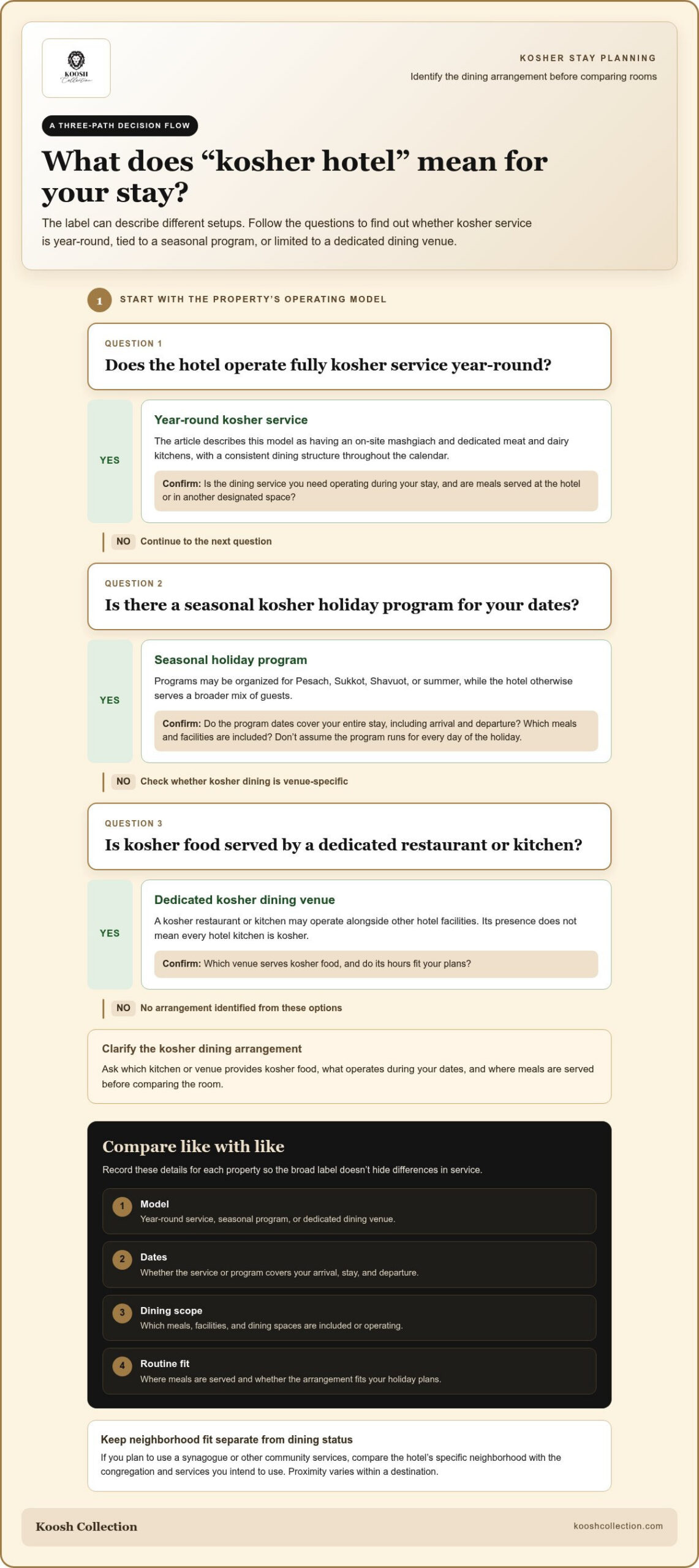
“Kosher hotel” can describe different arrangements, from year-round kosher amenities to a seasonal holiday program. The distinction affects where meals are prepared, which dining spaces operate, and what’s available during your dates. Identify the arrangement before comparing rooms: a kosher restaurant at a hotel doesn’t necessarily mean every hotel kitchen is kosher.
Some hotels operate fully kosher year-round, with an on-site mashgiach and dedicated meat and dairy kitchens. This model gives dining a consistent structure throughout the calendar. Before booking, find out whether the dining service you need operates during your stay and whether meals are served at the hotel or in another designated space.
Other properties host seasonal kosher programs for Pesach, Sukkot, Shavuot, or summer. These programs may organize kosher dining for a defined period while the hotel otherwise serves a broader mix of guests. Match the program dates to your travel dates, then review which meals and facilities are included. Don’t assume a holiday program runs for every day of the holiday.
A third setup places a dedicated kosher restaurant or kitchen alongside other hotel facilities. In that case, consider the property’s overall dining offer separately from its kosher operation. A hotel may have a kosher restaurant without operating every kitchen under the same arrangement. Find out which venue serves kosher food and whether its hours fit your plans.
U.S. destinations with hotels near synagogues and Jewish communities include metropolitan areas with established Jewish populations. Compare the hotel’s specific neighborhood with the congregation and services you plan to use, since proximity varies within each destination.
Use these steps to compare arrangements:
- Identify the model: year-round kosher service, a seasonal program, or a dedicated kosher dining venue.
- Match the dates: confirm the program’s operating period covers your stay, including arrival and departure days.
- Clarify the dining scope: distinguish the kosher kitchen or restaurant from other hotel facilities.
- Consider your routine: assess where meals are served and how the arrangement fits your holiday plans.
These distinctions make comparisons more useful. Two hotels may both describe kosher dining, yet differ in whether service is year-round, seasonal, or limited to a dedicated venue. Record the arrangement beside each option. This keeps the focus on the dining experience your dates require, rather than on a broad label alone.
Arrival and departure dates
Holiday dates shape more than the nights on a reservation. Jewish holidays follow the Hebrew calendar, so their corresponding civil dates shift from year to year. Start with the calendar for your travel year, then mark the holiday’s beginning and end before choosing arrival and departure dates. This helps prevent a booking from covering the wrong nights.
Plan around the holiday eve, not only the first full day. A stay beginning on the holiday itself may leave little time for travel, check-in, or meal arrangements before observance begins. If you expect to arrive in the afternoon, account for the time needed to reach the hotel and settle in. Build that transition into your itinerary.
Departure timing deserves equal care. A checkout date that falls during the holiday may not fit your observance or travel plans. Compare the hotel’s stated checkout time with the holiday’s ending, and consider whether extending your stay would make the itinerary more workable. Don’t assume a standard checkout schedule will suit a holiday stay.
Use a simple date-planning sequence:
- Mark the boundaries: write down the holiday’s start and end for the travel year.
- Add travel time: choose an arrival that leaves room to reach the property and settle in beforehand.
- Review the final night: see whether departure falls during the holiday or after it ends.
- Compare the full stay: include any nights needed before or after observance, rather than counting only holiday days.
Calendar alignment can also affect which dates are practical. If a holiday begins near Shabbat, consider how your arrival and departure fit both observances. A Friday arrival, for instance, may require an earlier travel plan than a midweek trip. Focus on the time available to travel, check in, and prepare, not simply the weekday.
Keep the calendar and booking itinerary side by side. Record arrival, departure, holiday start and end, and any overlapping Shabbat periods. Then compare those dates with the reservation’s exact night count and check-in and checkout details. This makes mismatches visible before you finalize the booking.
As you shape your dates, compare your holiday travel window with the hotel stay details. A carefully chosen arrival and departure can make the stay’s timing, rather than just its location, work for your plans.
Hotel pricing and seasonality
Hotel rates for Jewish holiday travel reflect more than the room itself. Dates, length of stay, room category, and included dining can all shape the total. Pesach, Sukkot, and Shavuot may coincide with seasonal kosher programs, so compare exact stay dates and package details rather than judging by a nightly rate alone.
Start by separating the room rate from added services. A room-only reservation and a holiday arrangement with meals may meet different needs. Compare what each option includes, such as room type, dining access, and the days the arrangement operates. A lower initial rate may not represent the same overall stay.
Seasonality matters because holiday dates can attract travelers seeking specific kosher arrangements. Availability and rates may vary with the calendar, destination, length of stay, and room selection. For example, a stay during a seasonal Pesach program may be priced differently from a nearby date without that program. Compare equivalent dates and inclusions for a meaningful comparison.
Use this comparison checklist for each hotel:
- Match the dates: compare the same arrival and departure dates, including nights before or after the holiday.
- Compare room categories: record the selected room type and occupancy for each option.
- Review dining inclusions: note whether meals are included, offered separately, or tied to a seasonal program.
- Read the reservation terms: compare payment timing, cancellation conditions, and any card requirements.
Keep flexibility in view. A reservation with stricter change terms may suit fixed travel plans, while flexible dates can broaden your comparisons. Don’t compare a flexible rate with a restricted rate as if they were identical. Record the terms beside the total, then decide which arrangement best fits your schedule.
For a secure reservation, understand how the booking card is used. Depending on the stated terms, the card may hold the reservation or process payment. Read the conditions before submitting your details. If the room rate is uncertain, you may leave the card section blank and request rates and availability by email.
As you compare dates and room options, review the hotel stay details alongside your intended travel window. Then compare the same dates and booking conditions across your shortlist. This keeps the decision focused on equivalent stays, rather than treating different inclusions or terms as equal.
Price bands can help screen options, but the relevant figure is the total for matching dates, room categories, dining inclusions, and reservation terms. Since price bands describe accommodation costs, use them as a broad reference rather than assuming every rate covers the same services.
Review each property’s stated inclusions and booking conditions alongside its price band. A rate within one band may still reflect a different room category or dining arrangement from another option. Keeping those details together makes it easier to judge whether a quoted rate fits your needs and compare the overall stay fairly.
Questions to ask before booking
Before reserving, turn each essential detail into a specific question. This makes it easier to compare kosher arrangements, payment terms, and practical fit without relying on broad labels.
How can you verify kosher certification and holiday meal supervision? Request the certifying organization’s name and clarify which kitchen or dining venue it covers. Ask whether supervision applies throughout your stay, including holiday meals, rather than assuming a general kosher listing answers both questions.
Are there travel agencies or directories specializing in Jewish holiday hotel packages? Yes, specialized agencies and directories can help travelers find holiday-focused options. Compare each package’s dates, dining arrangements, room terms, and included services before deciding whether it fits your plans.
What security features should Jewish travelers look for when booking a hotel? For online reservations, look for a clear statement about transaction encryption and understand exactly how the card will be used. The reservation website states that transactions are protected with 256-bit AES-256 SSL encryption.
Review card details separately. Ask whether the card holds the reservation, pays a deposit, or covers the full booking, and note when any charge occurs. Read cancellation and change terms alongside the payment details. If the room rate is uncertain, you may leave the credit card section blank and request rates and availability by email.
Use this short checklist before submitting a reservation:
- Kosher scope: Which specific kitchen, restaurant, or meal service is covered?
- Holiday supervision: Does the stated arrangement apply on every booked holiday date?
- Package details: Which meals, room nights, and services are included?
- Card use: Is the card used to hold the room, take payment, or both?
- Change terms: What conditions apply if travel dates or plans change?
Keep the answers with your reservation details. For example, note the dining venue’s name beside the dates its kosher service operates. This helps prevent confusion between a hotel’s general restaurant offering and the specific holiday arrangement you intend to book.
Finally, compare the information shown before payment with your booking confirmation. Check that the dates, room selection, card terms, and dining details match your intended stay. A secure hotel booking for Jewish holidays depends on both protected payment handling and clear, consistent reservation information.
Which hotels have Shabbat-friendly features such as keyless entry alternatives and walkable services?
A hotel’s Shabbat suitability depends on practical details, not the label alone. Start with room access: ask whether you can enter without using an electronic key. A physical key or another non-electronic arrangement may meet this need. Clarify how it works at the entrance and on your guest-room floor, not just at check-in.
Room controls matter, too. Check whether lights, air conditioning, and motion sensors can be disabled. A motion-activated light, for example, could switch on when someone enters the room. Knowing how the controls operate helps you assess whether the space fits your Shabbat routine. Include these questions when comparing room options.
Walkability is another part of the picture. Check the route between the hotel, a synagogue, and kosher restaurants, rather than relying on a general distance. A nearby restaurant may still require a route that doesn’t work for your plans. Consider crossings, entrances, and the actual walking distance from the hotel door.
Travelers who plan to carry items outside a hotel on Shabbat should verify the local eruv status. Eruv boundaries are local, so a neighborhood name alone doesn’t establish whether a particular route is covered. Check the relevant area for your stay, then consider whether your hotel and planned destinations fall within it.
Use this room-and-neighborhood checklist:
- Room entry: What non-electronic method provides access to the room?
- Room systems: Can lights, air conditioning, and motion sensors be disabled?
- Walking routes: How do you reach the synagogue and kosher dining options on foot?
- Eruv: Does the local boundary cover the routes you intend to walk?
Some mainstream hotels may suit a Shabbat stay when kosher restaurants and synagogues are within walking distance. That combination doesn’t answer questions about electronic keys or room systems, so assess each feature separately. A nearby synagogue, for instance, can make the location convenient while room access still needs consideration.
Write down each answer beside the hotel name and room option. This makes comparisons clearer: one property may offer walkable services, while another may better match your room-access needs. Consider the full route and specific room, not just the hotel’s general description.
For your upcoming stay, explore the hotel stay details through Koosh Collection as you compare your Shabbat priorities and travel plans.
Before settling on a room, confirm there’s a workable way to access it without an electronic key. Make sure the arrangement applies to the room you plan to book, rather than assuming a general description covers every room option. If you can’t establish a workable alternative, weigh that uncertainty alongside the room and location considerations above.
Koosh Collection: hollywood florida hotels
Koosh Collection offers hotels in Hollywood, Florida, including options with year-round Kosher amenities for travelers comparing holiday stays. Explore its accommodations when you’re considering a stay in the area, and weigh location alongside the arrangements that matter to your trip. Consider your dates, dining needs, and Shabbat priorities together as you compare hotel choices.
A stay at Koosh Collection’s Hollywood properties can suit travelers looking for a hotel with year-round Kosher amenities. Review Koosh Collection’s hotel offerings as a next step in your comparison. Visit kooshcollection.com to explore the accommodations and plan your stay.
Shape your shortlist around the stay you want
Before choosing a hotel, decide which details are essential and which can remain flexible. A personal shortlist keeps the decision focused: prioritize the arrangements that support your observance, then weigh location and room preferences around them. This helps ensure your final choice reflects your travel needs, not just the first appealing option.
A secure hotel booking for Jewish holidays is ultimately about finding a stay that fits how you want to experience the holiday. Make your choice deliberately, with your dates and priorities in view.
Koosh Collection offers Hollywood, Florida hotels, including kosher hotel options in Florida. If South Florida is on your shortlist, explore whether a Hollywood stay suits your plans.
Explore the Hollywood hotel stay and take the next step toward a stay shaped around your priorities.
Frequently Asked Questions
What makes a hotel suitable for observing Jewish holidays?
A suitable hotel matches your observance needs with practical arrangements, not simply a broad label. Consider whether dining, room access, and nearby services fit your plans for each day. A family, for example, may need a different room setup or meal schedule than a solo traveler. Make a short priority list before comparing properties, then assess each option against those needs.
Which hotels offer kosher meals or holiday meal packages?
Some hotels provide year-round kosher amenities, while others host seasonal holiday dining or operate a dedicated kosher restaurant. Koosh Collection’s Dolce by Wyndham Hollywood provides year-round Kosher amenities. That description alone doesn’t establish whether a specific holiday meal package is included. Compare the stated arrangement with your dates and meal needs, distinguishing kosher amenities from a defined package or meal schedule.
What are typical hotel prices and minimum stays during major Jewish holidays?
Rates and minimum-stay conditions depend on holiday dates, room type, length of stay, and whether dining is part of a program. Compare offers for the same dates and occupancy, then review the total alongside each stay’s terms. A package may have different booking conditions from a room-only reservation. Read the specific offer carefully, especially if your plans require an early arrival or a stay beyond the holiday.
What hotel booking policies apply to cancellations and changes for Jewish holidays?
Cancellation and change terms are set out in the reservation conditions for the rate or package you select. Before booking, identify the cancellation deadline, whether changes are permitted, and how deposits or prepaid amounts are handled. If holiday dates may shift, compare the terms for a flexible rate with those for a more restrictive offer. Keep your confirmation so you can refer to the exact conditions.
How can I confirm a hotel accommodates Shabbat and holiday restrictions before booking?
Ask for details tied to your selected room and stay dates, then keep the answers with your reservation. Clarify room entry, lights, air conditioning, motion sensors, meal arrangements, and practical walking routes. If you plan to carry items outdoors on Shabbat, establish whether your intended route falls within the local eruv. A written record helps you compare the hotel’s answers with your observance needs.