

What makes a hotel the right fit when you want both an elevated stay and a specific kosher dining standard? A luxury hotel with mehadrin kosher dining brings together two distinct considerations: the quality of the hospitality and the stated standard of the food. One does not establish the other.
It is understandable to want comfort and clarity about dining. Broad kosher language can leave important questions unanswered, while a star rating or prestigious designation describes the hotel experience, not the food’s kashrut supervision. Keeping those details separate makes it easier to compare properties against your own priorities.
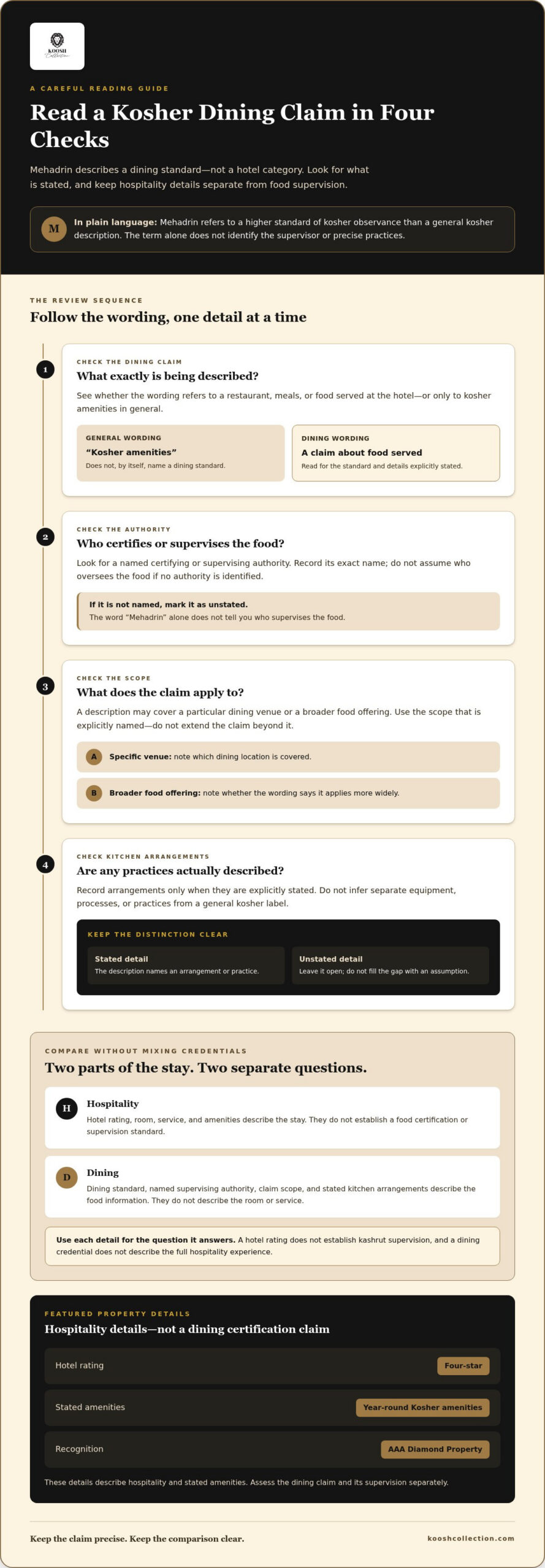
This guide explains how to read Mehadrin dining claims, identify useful details about supervision, and compare dining information with hotel amenities. Koosh Collection’s featured hotel is a four-star property with year-round Kosher amenities and AAA Diamond Property recognition. These details describe its hospitality and amenities. Use the steps below to assess dining claims carefully and plan a stay that fits your needs.
Key Takeaways
- Assess a luxury hotel with mehadrin kosher dining by its stated dining standard, not by its star rating or luxury positioning.
- Read kosher claims closely, distinguishing certification and supervision from kitchen arrangements and broader hotel amenities.
- Use a simple comparison to weigh dining credentials, hospitality, and service without treating it as a religious certification judgment.
- Define your dietary requirements and preferences before planning meals and comparing places to stay.
- Koosh Collection’s featured hotel is four-star, offers year-round Kosher amenities, and is an AAA Diamond Property. These are hospitality details to consider separately from dining information.
What Should a Luxury Hotel with Mehadrin Kosher Dining Offer?
Choosing a luxury stay while keeping to a particular kosher standard means weighing two things that matter in different ways: the hospitality experience and the supervision of the food. A comfortable room, attentive service, or prestigious hotel rating can shape your stay, but none tells you on its own what standard the dining follows.
Mehadrin describes a particular, more stringent approach to kashrut supervision. It is a dining standard, not a luxury-hotel category. Use that distinction as your starting point. A hotel may describe kosher amenities without naming a dining standard, while a Mehadrin claim concerns the food’s supervision, not the room or service level.
What does Mehadrin mean in hotel dining?
In plain language, Mehadrin refers to a higher standard of kosher observance than a general kosher description. The term alone, however, does not identify who supervises the food or explain the precise practices followed. Those details matter because standards and interpretations can vary among authorities.
Read the wording carefully. “Kosher-friendly” or “kosher amenities” may describe a general offering, while a specific dining claim should make the supervision clear. For a broader introduction to kosher dietary principles, see Kosher foods. Interpret any claim in light of guidance from your own trusted religious authority.
Why hospitality and dining credentials need separate evaluation
Think of the hotel and the dining as two complementary parts of one decision. A hotel rating speaks to hospitality; it does not establish a food certification. Likewise, a dining credential does not describe the room, service, or other amenities. Neither replaces the other.
Consider each claim on its own: the hotel’s stated rating and amenities, the dining standard named, and the supervising authority identified. Review a hotel’s dining information as one part of the picture, alongside its hospitality details. This makes it easier to compare a luxury hotel with mehadrin kosher dining without treating polished surroundings as evidence of a particular kashrut standard.
Koosh Collection’s featured hotel is a four-star property with year-round Kosher amenities and recognition as an AAA Diamond Property. These details help describe the hospitality experience and the stated amenities. When comparing dining, look at the food information and supervision details as their own criteria. That way, each credential answers the question it is meant to answer.
How to Read Kosher and Mehadrin Dining Claims with Care
A short description can make a hotel’s food offering sound reassuring while leaving the standard difficult to interpret. Read each phrase for what it actually states. “Kosher amenities,” for example, is not the same claim as a named dining certification, and luxury positioning or travel coverage does not establish Mehadrin supervision.
Read certification wording precisely: it identifies only the standard and scope explicitly named. A careful reading helps you distinguish published facts from the details you need to make a comfortable choice.
Which details help clarify a dining standard?
Use this brief checklist as you review a hotel’s published dining information:
- Dining claim: Does the wording refer to a restaurant, meals, or food served at the hotel, rather than kosher amenities in general?
- Authority: Is a certifying or supervising authority named? Record its exact name rather than assuming one.
- Scope: Does the description specify what the claim applies to, such as a particular dining venue or the hotel’s broader food offering?
- Kitchen arrangements: Are any arrangements described explicitly? Do not infer separate equipment, processes, or practices from a general kosher label.
Keep these details distinct. Certification identifies a stated standard; supervision names who oversees it; kitchen arrangements describe how food is handled; broader kosher amenities may relate to the stay without making a specific claim about dining. If a description leaves a point unstated, record it as unstated rather than filling the gap with an assumption.
How to compare hotel descriptions without overreading them
Compare the exact words used across hotel descriptions, not just category labels such as “kosher hotel.” One listing might describe year-round Kosher amenities; another might name a dining standard and its supervising authority. Those phrases communicate different things. A kosher dining overview can provide context about the food offering, while your own standards remain a separate part of the decision.
Read published claims alongside your personal requirements. A description can accurately state what a hotel offers without resolving whether it meets every traveler’s practice. For general food-safety context, the FDA’s FDA Food Safety Modernization Act (FSMA) resource addresses preventive controls for food safety. Food-safety information is distinct from kosher certification and does not establish a kashrut standard.
For a sense of the hospitality setting alongside your dining research, explore the featured four-star hotel. Its stated year-round Kosher amenities and AAA Diamond Property designation describe separate aspects of the stay. Keep those details alongside, but distinct from, the specific dining information you use in your comparison.
How to Compare Mehadrin Dining with the Rest of a Luxury Stay
A useful comparison keeps each promise in its proper place. A hotel’s star rating and its dining standard answer different questions. One helps describe the hospitality category; the other concerns the food’s stated kosher standard and supervision. Neither can stand in for the other.
Use this simple framework to organize what a hotel actually says. It is a decision aid, not a religious certification judgment, and it does not determine whether a particular offering meets your personal standards.
| What to compare | What to record |
|---|---|
| Dining standard | The exact wording used for the food offering, such as kosher or Mehadrin. Do not upgrade a general claim to a more specific one. |
| Supervision details | The certifying or supervising authority, if the hotel’s information names one. Keep the authority and the stated standard together. |
| Hotel amenities | Features or Kosher amenities the property explicitly describes. Koosh Collection’s featured property is a four-star hotel with year-round Kosher amenities. |
| Hospitality and service | The property’s published rating and service details. The featured property is recognized as an AAA Diamond Property, a hospitality credential rather than dining certification. |
Dining credentials versus hotel amenities
Keep the vocabulary exact. “Kosher” is a broad description; “Mehadrin” names a more specific standard; “Shabbat-friendly” refers to a different aspect of a stay. These terms are not interchangeable. Review the property’s hotel amenities overview for hospitality details, then consider dining claims separately. For background on certification and kosher standards, the kosher-practices resource provides information about kosher practices.
Luxury details that matter after dining requirements
Once you have recorded the dining details, consider what would make the stay feel right for you: room comfort, service, and atmosphere. Treat these as personal hospitality preferences, not evidence about food supervision. The AAA Diamond designation and four-star rating offer useful property context, but neither verifies a Mehadrin dining standard.
This distinction makes it easier to assess a luxury hotel with mehadrin kosher dining without allowing one attractive feature to answer a different question. Koosh Collection’s featured property brings together four-star accommodations, year-round Kosher amenities, and AAA Diamond Property recognition. Explore the featured hotel as part of your lodging comparison, and consider dining information separately against your own criteria.
How to Plan a Stay Around Your Kosher Dining Needs
A considered trip begins before you compare room photographs or hotel ratings. First decide what you need from the food offering, then use that standard to shape your lodging search. This order keeps personal dietary requirements distinct from preferences such as room style, atmosphere, or other hospitality details.
Individual practices differ. Use guidance from your trusted religious authority for questions about what meets your standard. The planning steps below are a practical way to organize your priorities, not a religious ruling.
Set your dining priorities before choosing a hotel
Write down the standard you personally require, using the terms and guidance you rely on. Then separate three questions: what meals or food access you need, what supervision standard matters to you, and which general hotel amenities would make the stay more comfortable. A broad kosher description may help with initial research, but it does not automatically answer a more specific requirement.
Not every traveler has the same priorities. One guest may need a particular level of food supervision; another may be weighing meal access alongside other needs. Naming the difference helps you assess descriptions on their own terms rather than assuming that a label means the same thing to everyone.
Bring dining and accommodation details into one plan
Once you have defined your priorities, move through the planning sequence in order:
- Define your personal standard. Record the dining requirement you intend to follow and any guidance you use to interpret it.
- Read the published claims. Note the exact language about meals, food supervision, and broader Kosher amenities. Keep each detail in its own category.
- Plan meal access. Map the meals you will need during the stay and compare that plan with the food information the property publishes. Do not assume that an amenity description answers questions about dining.
- Choose the lodging. After considering dining needs, weigh the room and hospitality details that matter to you.
A written checklist makes the comparison easier to revisit. Include your dining standard, meal needs, room priorities, and any Shabbat-related considerations that apply to your observance. If Shabbat planning is part of your trip, consider those practical needs alongside the dining plan. Guidance from your trusted authority can help with questions specific to your practice.
For the accommodation side of your checklist, the guest room overview can help you consider lodging choices separately from food requirements. Koosh Collection’s featured property is a four-star hotel with year-round Kosher amenities and AAA Diamond Property recognition. These stated details can inform your stay planning alongside your dining criteria.
For an upscale setting to consider as you bring those priorities together, explore the featured hotel. A clear plan lets you weigh its hospitality details alongside your own dining criteria, with each part of the decision kept in view.
A Refined Stay with Year-Round Kosher Amenities
A thoughtfully chosen stay brings together the details that matter to you, without asking one credential to stand in for another. Koosh Collection’s featured property is a four-star hotel with year-round Kosher amenities, and it is recognized as an AAA Diamond Property. Together, these stated details describe the hotel’s hospitality profile and amenities.
For anyone searching for a luxury hotel with mehadrin kosher dining, the dining standard and the hotel’s hospitality details are separate parts of the decision. A rating and amenities describe aspects of the stay; dining information describes the food offering. Read each detail on its own terms so you can compare properties with clarity.
What the hotel’s stated credentials tell a traveler
The four-star rating is a hotel credential, not an indicator of food supervision. Likewise, AAA Diamond Property recognition describes the property’s standing, not its dining certification. Year-round Kosher amenities are a separate stated feature. Read together, these facts identify an upscale hotel experience while leaving dining information to be assessed on its own.
Choose the experience that aligns with your priorities
Start with the needs that are essential to your stay, then weigh the hospitality details that shape the experience you want. A luxury setting and a specific dining standard may both matter, but they answer different questions. Keeping them distinct makes it easier to compare lodging based on its stated attributes and assess food claims according to your own standards.
For broader context on how travelers may think about an upscale kosher stay, explore this luxury kosher hotel guide. Use it as a companion to the practical distinctions in this article, not as a substitute for interpreting dining claims through your own trusted guidance.
Koosh Collection’s featured property brings together four-star accommodations, year-round Kosher amenities, and AAA Diamond Property recognition. These details can help you decide whether its stated hospitality experience fits your priorities as you consider dining information separately.
Explore the featured hotel and its stated experience as you consider your stay.
Make Your Next Stay a More Considered Choice
Before you reserve, turn your priorities into a brief you can return to: the dining standard you follow, the meal arrangements you need, and the kind of setting you hope to enjoy. This small step can make the search for a luxury hotel with mehadrin kosher dining more focused, especially when hotel descriptions use different language for food and hospitality.
Let your own standards guide how you interpret dining information, and use each property’s published details to picture the stay itself. A clear comparison helps you focus on what matters, from the food information to the atmosphere and hospitality.
Explore Koosh Collection’s featured hotel and its year-round Kosher amenities as you plan your stay. Consider the property’s four-star accommodations and AAA Diamond Property recognition alongside your dining priorities, and take the next step toward a more considered stay.
Frequently Asked Questions
What does Mehadrin mean when a hotel describes its dining?
Mehadrin refers to a more stringent kosher standard, but the word alone does not identify the supervising authority or explain which meals and venues it covers. Look for the exact wording attached to the food offering, rather than relying on a headline or general hotel description. If you follow a particular standard, use guidance from your trusted religious authority to interpret whether the published information aligns with your practice.
Is kosher-friendly dining the same as Mehadrin dining?
No. “Kosher-friendly” is a broad phrase that may describe a hotel’s general approach or amenities, while Mehadrin refers to a particular level of kosher supervision. For example, a property might mention year-round Kosher amenities without specifying a dining standard. Treat those as separate claims, and do not assume that a welcoming description, travel article, or restaurant mention establishes a specific certification.
How can I compare kosher certification details between hotels?
Make a small comparison note for each property: copy the precise dining claim, record any named supervising authority, and note what food or venue the information covers. Keep kitchen arrangements and general amenities in separate fields. If one hotel names an authority and another uses only broad wording, record that difference without deciding that either meets your personal standard. Your trusted religious authority can help interpret unfamiliar supervision details.
Can a hotel’s star rating tell me anything about its kosher dining standard?
No. A star rating describes the hotel’s hospitality category, not the supervision of its food. A high rating may help you compare lodging, but it cannot establish whether meals meet a particular kosher standard. Keep the questions distinct: assess the property’s published hospitality details for the stay, then review the dining information independently. That separation prevents an impressive hotel profile from being mistaken for a food credential.
What should I consider when planning kosher meals during a hotel stay?
Start by mapping which meals you will need during the trip, including arrival and departure days, then compare that schedule with the hotel’s stated food information. Note whether your plans depend on dining at the property or making other arrangements. If Shabbat observance affects your stay, include relevant practical considerations in your plan and follow guidance from your trusted authority. Requirements differ, so build around your own practice rather than a general checklist alone.
Does year-round kosher hospitality mean every dining option follows the same standard?
Not necessarily. “Year-round Kosher amenities” describes a broad hospitality offering; it does not, by itself, specify a certification level or establish that every food option follows the same supervision. Koosh Collection describes its featured property as offering year-round Kosher amenities. Read that statement as written, and keep it distinct from any separate claim about a dining venue, supervising authority, or Mehadrin standard.
How should I choose a luxury hotel when dining requirements are my priority?
Set your non-negotiable dining standard first, then compare published food claims against it before weighing room style, service, and atmosphere. If you are searching for a luxury hotel with mehadrin kosher dining, look for explicit wording about the dining standard and its supervision rather than inferring it from luxury branding. Use your trusted religious guidance for personal decisions, then choose the stay whose stated hospitality details fit the experience you want.