
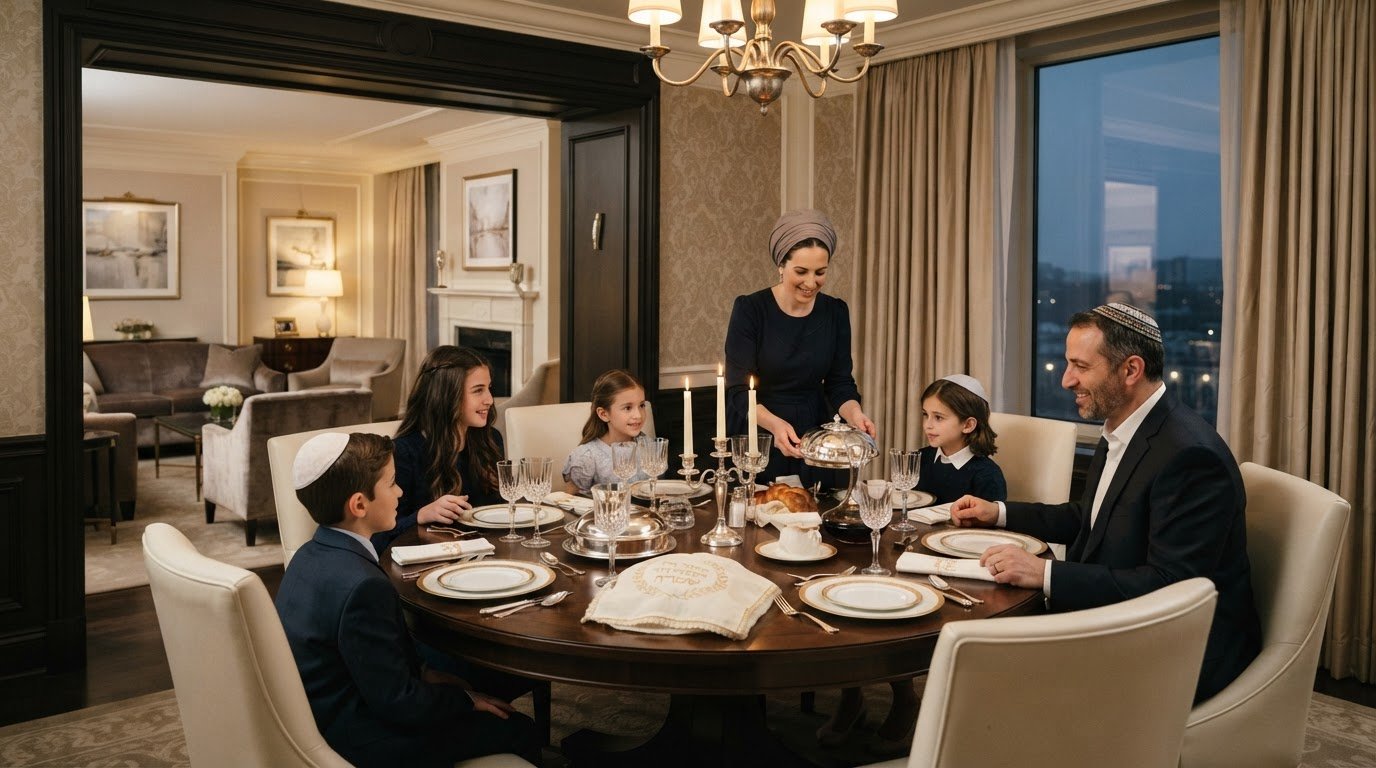
The most polished hotel description can still leave a family’s essential questions unanswered. A luxury hotel for orthodox jewish families should be evaluated by confirmed details, not by a broad promise of kosher or Shabbat-friendly hospitality.
That distinction matters. Your family may need to confirm the level of kosher supervision, how meals are arranged, whether room access and lighting suit your Shabbat practice, and which room configurations are available. Services can vary by property and travel dates, and seasonal programs may require separate confirmation. An elegant setting is only part of the picture; peace of mind begins before you reserve.
This 2026 guide explains how to compare hotel services with your family’s observance and comfort needs. Use the practical questions about dining, Shabbat arrangements, room setup, and seasonal offerings to get clear, date-specific answers directly from the property. The goal is a stay that feels special, with expectations understood before arrival.
Key Takeaways
- Choose a luxury hotel for orthodox jewish families by matching confirmed services to your household’s observance needs, rather than relying on broad labels.
- Assess kosher dining separately from room arrangements. Clarify the supervision, meal options, and service details that meet your standards.
- Use a comparison table to weigh observance fit alongside room comfort, family suitability, and hospitality expectations.
- Ask about your travel dates, requested services, room setup, and applicable policies, then keep a record of the answers.
- Consider the featured Dolce by Wyndham stay after defining your must-haves, and confirm each essential detail directly before booking.
What Makes a Luxury Hotel Right for Orthodox Jewish Families?
A luxury hotel is right for an Orthodox family when its confirmed services meet that household’s kosher, Shabbat, and room requirements, as well as its expectations for comfort and quality. The label alone can’t establish that fit. A polished suite or appealing amenities may enhance a stay, but they don’t answer practical questions about meals, room access, or observance arrangements.
Assess two things separately. First, consider the stay itself: room comfort, service expectations, space for your family, and amenities that matter to your plans. Then assess observance fit using clear, property-specific answers. The Kosher tourism overview offers context on the connection between travel and religious needs, but your household’s requirements should guide the final decision.
There’s no single checklist that suits every family. Standards and preferences can vary by household, community, and occasion. A short trip with older children may call for different arrangements than a longer stay with young children. Start with what would make the stay workable, then identify the details that would make it more comfortable.
Which needs should families define before comparing hotels?
Write down requirements for every traveler before reviewing properties. Separate non-negotiables from preferences so that a desirable amenity doesn’t distract from an essential arrangement. Your group’s size, children’s routines, and length of stay can all affect room needs and meal planning. A concise list also makes it easier to ask each hotel the same questions.
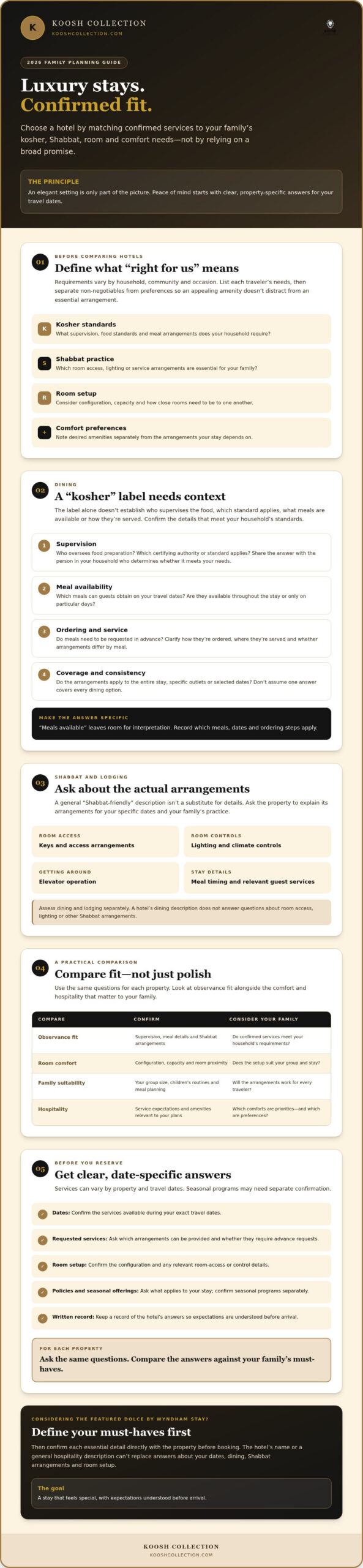
- Kosher: What supervision, food standards, and meal arrangements does your household require?
- Shabbat: Which arrangements for room access, lighting, or services are essential to your practice?
- Rooms: What configuration, capacity, and proximity between rooms would suit your family?
- Preferences: Which amenities, such as leisure facilities, would be welcome but aren’t essential?
Why does the word kosher need context?
A hotel’s use of “kosher” doesn’t explain who supervises the food, which standard applies, what meals are available, or how they’re served. Ask the property to identify its certifying authority and describe its dining arrangements. Then decide whether those details meet your household’s standards. Confirm current information directly rather than relying on a general description.
A kosher label is a starting point, not a substitute for confirming the supervision and meal arrangements your family requires.
How to Assess Kosher Dining and Shabbat Arrangements at a Luxury Hotel
Check dining and lodging separately. A hotel may describe its hospitality as kosher-friendly, but that phrase alone doesn’t tell you who supervises food preparation, which standard applies, or how meals are provided. Hospitality coverage of the global market for kosher foods reflects wider interest in kosher dining. For your decision, focus on details that match your household’s practice.
What should families confirm about kosher meals?
Ask for specifics rather than a yes-or-no answer. The same questions can help you compare properties and identify arrangements to make before arrival.
- Supervision: Who oversees food preparation, and which certifying authority or standard applies? Share the answer with the person in your household who determines whether it meets your needs.
- Meal availability: Which meals can guests obtain on your travel dates? Ask whether dining is available throughout the stay or only on particular days.
- Ordering and service: Do meals need to be requested in advance? Clarify how they’re ordered, where they’re served, and whether the arrangements differ by meal.
- Consistency: Do the stated kosher arrangements cover the entire stay, specific outlets, or selected dates? Don’t assume one answer applies to every dining option.
Record the response precisely. “Meals available” leaves room for interpretation. A clear explanation of which meals, dates, and ordering steps apply is more useful when you’re comparing properties.
Which Shabbat details are worth asking about?
Ask the hotel to describe its arrangements for your specific dates instead of relying on a general Shabbat-friendly label. Depending on your family’s practice, ask about room access, keys, lighting or climate controls, elevator operation, meal timing, and relevant guest services. Treat these as questions to confirm, not features to assume.
Shabbat suitability depends on confirmed arrangements and each household’s needs. If a detail is essential, request a direct answer and clarify whether it will be available during your stay. A general description may not explain how an arrangement works in practice or whether it applies to your room and dates.
Families considering the featured hotel can use these questions as a starting point, then confirm current dining supervision, meal arrangements, and Shabbat details directly before booking. This helps turn a promising description into a better-informed choice for a luxury hotel for orthodox jewish families.
How to Compare Luxury Hotels for Orthodox Jewish Families
A side-by-side comparison helps you see which property’s confirmed services align with your family’s priorities. Don’t score a hotel based on a feature you haven’t verified. Record what the property confirms, what remains a question, and how much each detail matters to your household.
Which comparison criteria matter most to families?
Start with your non-negotiables. Rank kosher dining and Shabbat arrangements according to your own standards, then compare room configuration, comfort, and suitability for your family’s size and routines. A detail that’s essential to one household may be a preference for another.
Clarity matters, too. Note whether the hotel gives a direct answer, refers you to someone who can clarify, or leaves a point unresolved. An unknown isn’t proof that a service is unavailable; it’s a reason to ask before deciding.
How can a comparison table prevent surprises?
Use the same criteria for each property, and record the date and source of every answer, such as an email or direct conversation. Mark each item as confirmed, requested, possible, unavailable, or still unknown. Then rate its importance as must-have, preferred, or not needed. This keeps assumptions separate from confirmed information.
| Requirement | Hotel response | Confirmation status | Importance |
|---|---|---|---|
| Kosher supervision | Record authority or standard provided | Confirmed / question | Must-have / preferred / not needed |
| Shabbat arrangements | Record details for your dates | Confirmed / question | Must-have / preferred / not needed |
| Room configuration | Record room details provided | Confirmed / requested / unknown | Must-have / preferred / not needed |
| Family comfort | Record relevant amenities or policies | Confirmed / question | Must-have / preferred / not needed |
Use the table to compare observance fit with the quality of stay you want. A spacious room or appealing amenity can be valuable, but it shouldn’t obscure an unanswered must-have. For a luxury hotel for orthodox jewish families, the strongest candidate is the one whose verified details meet your essential requirements and whose remaining uncertainties are clear enough to resolve.
For further reading, look for the published guide Defining Excellence: The Ultimate Guide to the Luxury Kosher Hotel. Pair broader guidance with direct, date-specific confirmation from each property before you reserve.
What to Ask Before Booking a Luxury Hotel for an Orthodox Family
A careful booking process turns broad descriptions into a clear plan. For a luxury hotel for orthodox jewish families, work through four steps: define your needs, contact the hotel, record its answers, then reconfirm essential arrangements before arrival. Keep your questions specific to your family and travel dates.
What should you ask the hotel directly?
Start with your exact dates and must-haves. Ask which kosher dining and Shabbat arrangements are available then, and request details about supervision, meal service, and any room arrangements relevant to your observance. If something is essential, ask the hotel to confirm it applies to your stay, not just in general.
- Dates and services: Which requested dining and observance-related services are available throughout your intended stay?
- Rooms: Which room configurations may suit your party, and how should you submit a request? Ask whether an arrangement is confirmed, subject to availability, or not offered.
- Policies: Are there applicable policies, timing requirements, or steps your family should know about before booking?
- Follow-up: Who or which department can clarify observance-related questions before arrival?
Don’t treat a request as confirmed simply because it’s been noted. Ask for a clear response, and have any essential detail confirmed in writing before completing the reservation.
How can families confirm arrangements before arrival?
Keep the hotel’s written responses with your reservation details. Note the date and the staff member or department that provided each answer. If a response is unclear, follow up with a direct question rather than filling in the gaps yourself. Review the hotel’s room information, then verify whether the configuration you need can be requested for your dates.
Reconfirm essential arrangements closer to the stay, especially if your dates, party size, or requirements change. Compare the hotel’s latest answers with your original list and flag anything that has shifted from confirmed to uncertain. For additional Shabbat-planning context, consult The Art of the Observant Stay alongside your household’s own guidance.
Considering the featured property? Review the featured hotel details, then contact the property directly to confirm current services, room requests, and policies for your intended dates.
Considering the Featured Dolce by Wyndham Stay for Your Family
The featured Dolce by Wyndham stay is an option to evaluate against your family’s requirements, not an automatic match for every household. Treat the hotel’s pages as a starting point for research. Confirm current services and availability directly before making a reservation, especially for observance-related details that matter to your plans.
How can families evaluate the featured hotel against their needs?
Return to your must-have list and compare each item with a specific answer from the property. For example, note whether the kosher supervision and dining arrangements meet your household’s standards, whether Shabbat arrangements are confirmed for your dates, and whether the proposed room setup suits your group. If an answer is missing or unclear, mark it as a question rather than assuming the detail is available.
Review the room information to consider the accommodation options described, then contact the property about the configuration and requests relevant to your family. Page descriptions can help you compare, but they don’t confirm that a particular room arrangement is available for your dates. Apply the same care to family amenities: distinguish what a page describes from what the hotel confirms for your stay.
What should happen before making the final reservation?
Before you commit, make one final pass through the essentials. Confirm your travel dates, kosher and Shabbat arrangements, room requests, and applicable conditions directly with the property. Keep written responses with your reservation information. If a detail remains unresolved, ask for clarification and decide whether it affects a non-negotiable need.
- Dates: Are the arrangements you need available throughout your intended stay?
- Observance: Have the relevant dining and Shabbat details been confirmed for those dates?
- Rooms: Has the property addressed your room configuration request, including any limits or conditions?
- Amenities: Use the hotel’s amenities page as a reference, then verify any essential feature directly instead of treating a page listing as confirmation.
For a luxury hotel for orthodox jewish families, confidence comes from a clear match between your priorities and confirmed arrangements. Once you’ve checked the details that matter most, explore the featured hotel as you consider your next step.
Choose Your Stay With Confidence
The right luxury hotel for orthodox jewish families is the one that matches your household’s needs, not simply the one with the most impressive description. Confirm kosher supervision and meal arrangements, ask how Shabbat services apply to your travel dates, and verify room requests before reserving. Keep essential answers in writing, and distinguish confirmed details from preferences or open questions.
Koosh Collection focuses on luxury hotel accommodations, with an emphasis on kosher-friendly and Shabbat-friendly hospitality. Its featured Dolce by Wyndham stay may be worth evaluating once you’ve defined your family’s priorities. Services and availability can vary by property and date, so confirm every essential detail directly with the hotel.
Explore the featured hotel, then compare its confirmed arrangements with your checklist. Contact the property directly with your questions and decide whether the available details fit your family’s needs.
Frequently Asked Questions
Is a luxury hotel automatically suitable for Orthodox Jewish families?
No. A luxury rating describes the hospitality experience, not whether a hotel meets your family’s kosher or Shabbat requirements. Ask which services are available during your dates, what standards apply, and how each arrangement works in practice. Compare the answers with your household’s needs, and confirm essential details directly with the hotel before reserving. A polished setting matters, but verified suitability is what helps make the stay comfortable.
What should Orthodox families ask about kosher food at a hotel?
Ask who supervises the food, which certification or standard applies, and what meals are available. Clarify how and when meals are served, whether you need to order in advance, and whether arrangements cover every day of your stay or only selected dates. Your family should decide which standards meet its needs. Request clear confirmation from the hotel rather than relying on a general description of kosher dining.
How can a family check whether a hotel is Shabbat-friendly?
Ask the hotel to describe its current Shabbat arrangements and confirm they’ll be available on your travel dates. Identify what matters to your household, then ask specific questions about relevant room access, lighting, elevator operation, or services without assuming any feature is provided. Record the answers and reconfirm essential arrangements before arrival, particularly if your reservation or requirements change. A general label alone can’t establish that a hotel fits your practice.
Can Orthodox families stay comfortably at a hotel without a full kosher program?
Possibly, depending on your family’s requirements and the arrangements the hotel can confirm. Some households may require supervised meals or particular Shabbat provisions; others may have different needs and plans. Don’t assume a hotel can accommodate a specific practice. Discuss your requirements directly, assess the answers, and decide whether the confirmed arrangements are suitable. If an essential need remains unresolved, consider that uncertainty before committing to the stay.
What room details should families confirm before booking?
Check available room configurations, occupancy details, and any requests that matter to your family’s comfort. Ask whether the hotel can confirm your preferred arrangement or whether it’s subject to availability. Review the hotel’s room information, then contact the property about questions the page doesn’t answer. Keep written confirmation of essential requests with your reservation details, and reconfirm them before arrival, especially if your party size or needs change.
When should Orthodox families contact a hotel about observance needs?
Contact the hotel before booking if kosher dining, Shabbat arrangements, or a particular room request is essential. An early enquiry gives you time to compare responses and make an informed choice. Ask about availability for your exact dates, keep important answers in writing, and check again closer to arrival. General descriptions can help you identify questions, but they shouldn’t be treated as confirmation that a specific service will be available.