

The best luxury hotels for Jewish travelers are defined by more than elegant rooms: look for the level of kosher supervision, practical Shabbat access, and facilities that suit your observance. A fully kosher hotel has every food item, dining hall, and on-site kitchen under strict kosher supervision. Seasonal programs may make a hotel entirely kosher for a set period, while Shabbat-friendly details such as room entry without an electronic key can shape the stay.
Luxury and religious fit should feel seamless, not like competing priorities. You may want excellent dining, thoughtful service, and a memorable setting alongside arrangements that support your traditions. This guide explains how kosher supervision and seasonal programs differ, what to consider for Shabbat access and lighting, and how Jewish facilities and location can influence your choice. Knowing what matters most can help you choose a stay that suits your travel style.
Key Takeaways
- Distinguish year-round kosher operations from seasonal programs, which may transform a hotel’s food service for a specific period.
- Plan Shabbat room access around electronic keys, automatic lighting, air conditioning, motion sensors, and elevator arrangements.
- Weigh resort surroundings and nearby attractions alongside the hotel’s religious amenities when choosing a location.
- Consider whether an on-site synagogue or local eruv fits your Shabbat plans, including where you intend to carry items.
- Understand who supervises the hotel’s food service and what the supervision covers to assess whether it meets your kashrut needs.
1. Year-round kosher hotels, seasonal programs, and Shabbat-friendly hotels
Luxury hotels differ in kosher supervision, Shabbat access, location, and dining arrangements. To compare value, weigh the food program and religious facilities against the setting and the services your vacation requires.
A year-round kosher hotel keeps every food item, dining hall, and on-site kitchen under strict kosher supervision. A seasonal program can make a hotel entirely kosher for a defined period, such as Passover or summer holidays. This difference matters: a traveler visiting outside program dates may encounter a different dining setup. Match your travel dates to the hotel’s stated schedule, then compare which dining options remain available throughout the stay.
Supervision means more than a label beside a menu. Consider who oversees food preparation and which kitchens, ingredients, and dining spaces are covered. A dedicated kosher kitchen can separate kosher preparation from other hotel food service. A dedicated restaurant may offer a focused dining experience, but its opening dates and meal schedule affect how well it fits. Compare breakfast and dinner arrangements rather than assuming one covers both.
Seasonality can also affect package details and value. A holiday program may include a broader kosher dining offering during scheduled dates, while a year-round property may provide a steadier option across travel periods. Compare package inclusions, such as meals or dining access, and account for your dates. Seasonal demand can affect rates, so compare the complete stay, not only the room cost.
Shabbat-friendly features are separate from kosher food. Consider room access without an electronic key and the handling of automatic lights, air conditioning, and motion sensors. For a Florida vacation, location can also affect access to Jewish facilities and dining. Look for a balance between these practical details and the resort setting, rather than choosing on luxury alone.
When comparing kosher luxury vacation packages in the United States, weigh the hotel’s supervision and meal arrangements against your itinerary and travel dates. Look for clear details about included meals, where kosher dining takes place, and whether the program runs year-round or during selected holidays. A dedicated kitchen, seasonal schedule, and Shabbat arrangements each offer different benefits. Choose the combination that suits your observance, preferred destination, and pace of travel.
2. Shabbat room access, lighting, and elevators
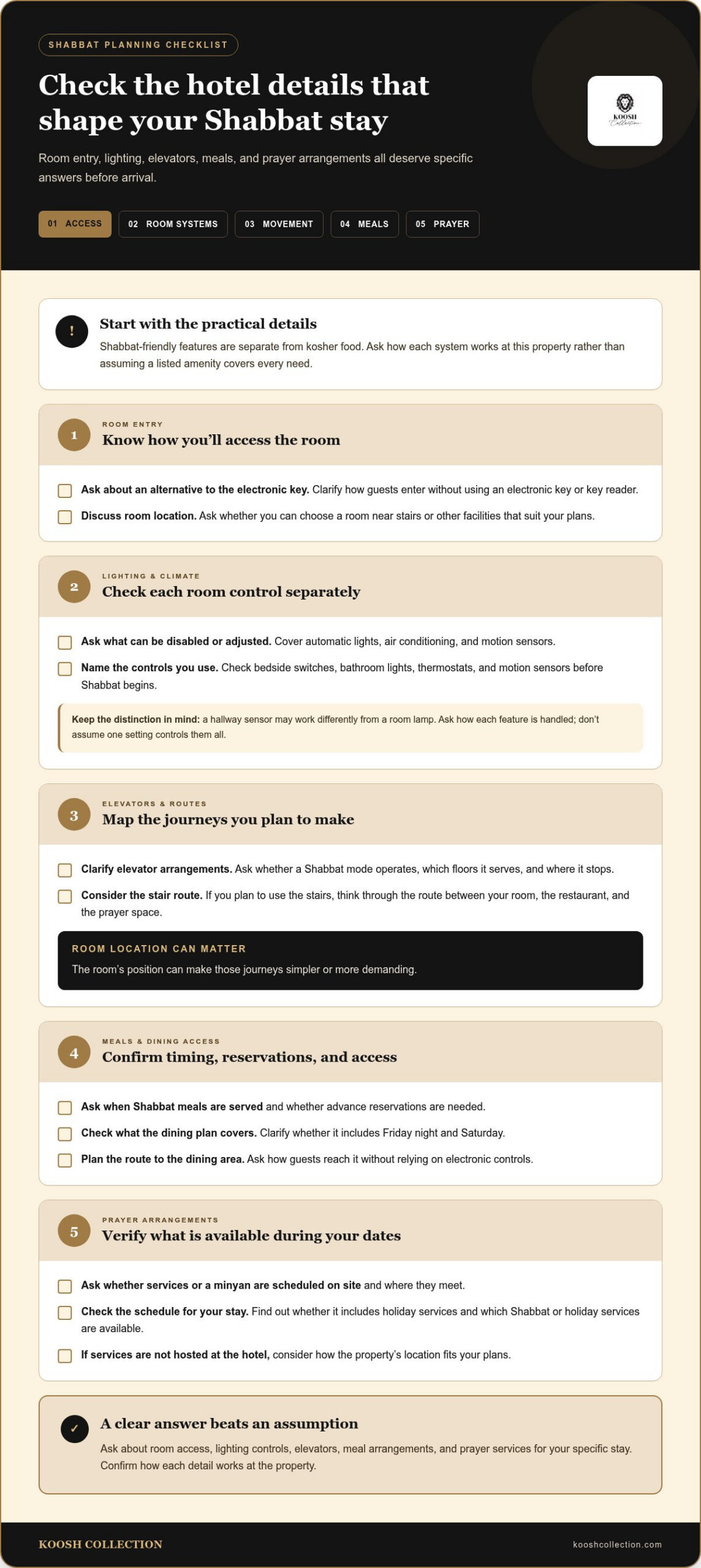
Ask how guests can access their rooms without an electronic key, and whether automatic lights, air conditioning, and motion sensors can be disabled for Shabbat. Clarify elevator arrangements, including whether a Shabbat mode operates and which floors it serves. These practical details can affect how you move around the hotel more than the room’s furnishings.
Before booking, ask which Shabbat and holiday services are available during your stay, including room access, lighting controls, meals, and prayer arrangements. Clarify where meals are served, how reservations work, and whether the dining plan covers Friday night and Saturday. Ask whether a mashgiach supervises the food service and what that supervision covers.
Room access deserves particular attention. An electronic key may activate a lock or require a reader, so ask what alternative guests can use during Shabbat. Also ask whether you can choose a room near stairs or other facilities that suit your plans. Clear answers help you understand the hotel’s layout before arrival, beyond its listed amenities.
Lighting and climate controls can involve several systems in one room. Ask whether bedside switches, bathroom lights, thermostats, and motion sensors can be adjusted before Shabbat begins. A hallway sensor, for example, may work differently from a room lamp. Find out how the property handles each feature instead of assuming one setting controls them all.
Elevators merit a separate conversation, especially in a high-rise hotel. Ask whether an elevator has a Shabbat mode, which floors it serves, and where it stops. If you plan to use the stairs, consider the route between your room, the restaurant, and the prayer space. Your room’s location can make those journeys simpler or more demanding.
Prayer arrangements vary by property and date. Ask whether services or a minyan are scheduled on site, where they meet, and whether the schedule includes holiday services. If the hotel does not host services, consider how its location fits your plans. Do not assume a prayer room, synagogue, or minyan is available simply because a hotel welcomes Jewish guests.
Confirm meal timing and access separately from the menu. Ask when Shabbat meals are served, whether advance reservations are needed, and how guests reach the dining area without relying on electronic controls. For a Florida stay, you can also explore a Hollywood hotel setting as one possible base for your plans.
3. Resort locations and nearby attractions
A resort’s setting shapes the rhythm of a Jewish vacation: nearby dining, walking routes, and attractions all matter. The Altair Hotel offers one clear Florida example, with Bal Harbour Shops and South Beach a 10-minute drive away. Compare a hotel’s surroundings with the places you plan to visit, then consider how those journeys fit around Shabbat and holiday plans. A striking view can be appealing, but practical access may matter more across the full stay.
An eruv can affect how guests plan movement beyond a resort. Before choosing a US property, find out whether an eruv serves the hotel area and which routes it covers. If you plan to carry items outside the hotel, check the local eruv’s status and boundaries for your travel dates. Property grounds alone may not show where the eruv applies, so compare its boundaries with your planned walks.
For a Florida resort stay, start with your itinerary, not just the scenery. List the places you hope to visit, meals you need, and Shabbat arrangements that shape your days. Then compare the resort’s location with those plans and available kosher dining. A fully kosher program differs from a hotel with limited kosher service, so weigh supervision and meal access alongside proximity to beaches, shopping, or other planned attractions.
US resort destinations vary in setting and pace. Compare each property on its own terms, starting with its location and travel between the hotel and your planned activities. When mapping walks, excursions, and regional highlights, travel guides on searchland.club can help you evaluate destination options and logistics. For each stop, consider whether kosher dining and Shabbat arrangements fit your itinerary. Do not assume one hotel’s amenities or food arrangements apply to another property, even in the same destination.
Use a simple comparison before choosing. Note the resort’s location, nearby attractions, kosher dining arrangements, and Shabbat considerations. Include the season, since seasonal programs may change what a hotel provides. If travel companions have different priorities, agree on essential details together. Share personal religious requirements with hotel staff only with the traveler’s consent. This keeps the decision grounded in your plans, not a destination’s reputation.
If your plans depend on an eruv, make its boundaries part of the location decision. A resort may be close to attractions beyond the area you intend to walk, so map each route before choosing a hotel. In South Florida, the Altair Hotel’s proximity to Bal Harbour Shops and South Beach gives travelers nearby destinations to weigh against dining, supervision, and Shabbat needs. Let your full itinerary guide the choice.
4. On-site synagogues and Jewish facilities
An on-site synagogue can make it easier to plan your stay around prayer, community, and rest. Compare its location with guest rooms, dining areas, and entrances. Ask whether the space hosts services or opens only on selected dates. A dedicated prayer room may offer a quiet space without functioning as a synagogue. These distinctions help you assess what the hotel’s Jewish facilities contribute to your stay.
For synagogue group travel, start with the group’s needs: shared prayer space, meal arrangements, and room locations. A community traveling together may value a private gathering area, while individual guests may prefer a nearby synagogue. Clarify whether the hotel’s facilities support your schedule, including Shabbat and holiday plans. A welcoming atmosphere matters, but practical access and service times determine how well the setting works.
Location matters beyond the hotel grounds. Map nearby synagogues, walking routes, and the distance between the property and planned services. For a US resort stay, consider whether a synagogue is within a route suited to your Shabbat observance. An eruv’s boundaries can also affect plans for carrying items outdoors. Check the local eruv’s current status and boundaries for your travel dates, then compare them with the routes you expect to use.
If you plan to carry items outside the hotel, include the eruv’s boundaries in your route planning. Do not assume resort grounds, a nearby beach, and surrounding streets share the same status. Map the walk from your room to an outdoor dining area, for example, and determine whether it falls within the relevant boundary. This practical step can matter even at a luxury hotel with Jewish facilities on site.
Group organizers can clarify priorities with a short planning brief. Include the expected prayer schedule, preferred synagogue access, meal needs, and room-location preferences. Share personal religious requirements only with each traveler’s consent. A family group may prioritize proximity to a prayer space, while a community group may need a shared meeting area. These details help distinguish a suitable property from one with only a general Jewish-friendly description.
When comparing US resorts, treat an on-site synagogue, a nearby synagogue, and a private prayer room as different offerings. Note which facility supports your plans, when it is available, and how guests reach it. Then compare those details with local eruv boundaries and your intended routes. A hotel’s location and nearby Jewish facilities can shape your stay as much as its amenities, so weigh each against your group’s itinerary.
5. Hotel kashrut supervision and certification
A hotel’s kosher description can cover different parts of its food service. One property may supervise its main kitchen, while another serves kosher meals through a separate restaurant or package. Read the description for its scope, not just as a label. Identify which kitchens prepare food, which dining areas serve it, and whether the stated supervision applies throughout your stay.
Certification details help clarify that scope. Look for the supervising organization’s name, the food operation covered, and any dates or program period shown. A certificate for one restaurant does not automatically cover every kitchen on the property. A hotel may, for example, have a dedicated kosher restaurant while other dining venues operate separately. Compare the document’s coverage with the meals you plan to eat there.
Ask how food service works across the full package. Does it include breakfast, dinner, room service, or selected meals only? Which kitchen prepares each meal, and where is it served? These questions clarify whether the package fits your itinerary. A boutique hotel with one dining room may work differently from a resort with several restaurants and kitchens, even when both advertise kosher dining.
Supervision also helps you assess menus and meal arrangements. Note whether the description names a mashgiach or another supervisory process, and which food preparation it covers. Do not assume a kosher restaurant’s status extends to catered events or in-room dining. If you follow particular standards, compare them with the stated supervision and the specific kitchen or service you intend to use.
Destination can change the practical picture. Travelers to Dubai should confirm kosher service availability in advance, since hotel dining arrangements can vary by property and travel period. Chabad may be a useful reference for local Jewish life, but distinguish community dining from a hotel’s own certified food operation. Keep certification scope and your planned meals central to the comparison.
For a clear comparison, record the supervising organization, covered kitchens, restaurant access, meal package, and operating dates. Then match those details against your travel schedule and dietary standards. A luxury hotel’s design or service level doesn’t establish its kashrut supervision. For a Florida stay, explore the Hollywood hotel property as you consider accommodations alongside your kosher dining needs.
Koosh Collection: hollywood florida hotels
Koosh Collection offers luxury hotel accommodations featuring upscale amenities and premier service. If your travel plans point toward a destination with vibrant local culture, its properties provide a refined option to consider alongside your priorities for kosher travel. The collection includes exceptional hotel choices, helping travelers focus their search on an exclusive destination. Compare the setting and accommodation with the kosher and Shabbat arrangements that matter to your stay, using the criteria outlined above. For a trip centered on personalized comfort, explore Koosh Collection as a natural next step. Contact Koosh Collection to discuss your stay.
Choose a stay that feels right for your journey
The best luxury hotels for Jewish travelers are those that fit how you want to spend your time, not simply those with the grandest setting. Let your priorities guide the final choice, whether that means a particular dining arrangement, a restful Shabbat, or a destination to explore at your own pace.
For travelers drawn to South Florida, Koosh Collection offers Hollywood, Florida hotels, including kosher hotel options in the area. Its hotels in Hollywood, FL, provide a starting point for considering a stay that brings your destination and travel preferences together. Make your next step a closer look at the property and how it fits your plans.
Contact Koosh Collection about your stay, and begin shaping a Florida getaway that feels distinctly your own.
Frequently Asked Questions
What luxury hotels offer kosher dining or nearby kosher restaurants?
Look for hotels with a kosher restaurant on site or a clear arrangement for nearby kosher dining. These are different setups: one keeps meals within the property, while the other makes location and travel time part of your plans. Koosh Collection features Dolce by Wyndham Hollywood among its hotel accommodations with year-round kosher amenities. Match the property’s dining arrangements to your itinerary and preferred meal routine.
Which luxury hotels provide Shabbat elevators, keyless entry alternatives, or other Shabbat accommodations?
Hotel policies and room features differ, so compare each detail with your plans. Travelers who avoid electronic keys, for example, may prioritize a property with an alternative way to access guest rooms. Elevator arrangements, lighting controls, and access to dining areas can also affect how you move through the hotel. Consider the full route between your room and the spaces you expect to use.
What luxury hotels are near synagogues or Chabad centers?
Choose a hotel based on the specific synagogue or Chabad center you plan to visit, not a broad neighborhood label. Map the route from the hotel entrance to your destination, including the walking path and any public areas along the way. For group travel, the route can influence meeting times and where guests prefer to stay. Keep service locations central to your itinerary.
Which destinations have luxury hotels with strong Jewish traveler amenities?
Florida, Miami, the Bahamas, and Israel each present different considerations for Jewish travelers. Compare specific properties rather than assuming a destination’s amenities apply to every hotel. An eruv’s boundaries, for example, can affect plans at a resort, while kosher meal arrangements depend on the property. Dolce by Wyndham Hollywood is one option for year-round Kosher amenities in a luxury hotel setting.
What are typical nightly prices and resort fees at recommended luxury hotels?
Nightly rates and resort fees depend on the property, travel dates, room category, and booking terms. Compare the total cost of the stay, not just the advertised room rate, and note which charges are mandatory or tied to selected amenities. A package that includes meals may offer a different overall value from a room-only stay. Use the same dates and room needs when comparing properties.
Do luxury hotels offer kosher meal plans, kosher kitchens, or advance kosher catering?
Some luxury properties offer kosher meal plans or dedicated kosher kitchens, while others arrange meals through selected dining services. Catering can also depend on the hotel’s food operation and event requirements. Before choosing a package, identify which meals it covers and whether the arrangements align with your dietary standards. A breakfast plan alone, for example, may not suit a stay that also requires Shabbat meals.
Which luxury hotels are within walking distance of synagogues and kosher shops?
Walking distance depends on the exact hotel entrance, destination, and route, so compare specific addresses rather than relying on a general area description. Map the walk to the synagogue and kosher shops you plan to visit, then consider whether the route suits your Shabbat plans. If an eruv matters, its boundaries may affect which destinations fit your intended walk. A map can help clarify which location works best.