
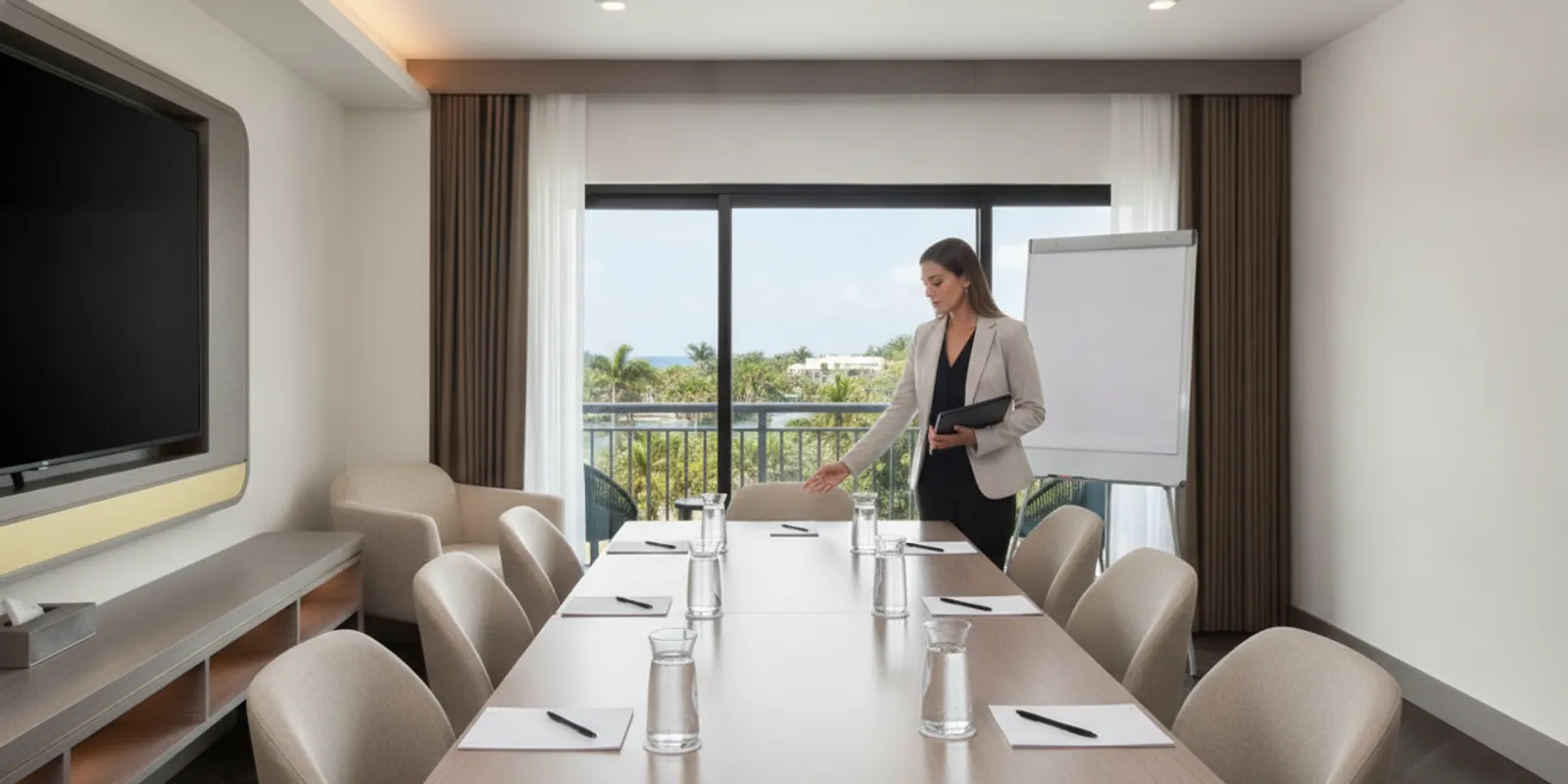
A useful hotel event venue comparison in South Florida starts with more than a room photo or a headline capacity. Planners need to understand where guests will stay, how the event will move from one part of the program to the next, what dining is actually available, and which details still need confirmation. This checklist helps you compare venues on those practical points—and separates published information about Koosh Collection properties from items a planner should verify directly.
Explore Dolce room availability
Start With the Event You Need to Host
Before comparing hotels, describe the event in operational terms. “A meeting for 100” does not tell a venue whether you need one room for a full day, a general session followed by breakouts, a reception, overnight rooms, or space for a meal. Build a short event brief that gives each hotel the same starting point.
- Program: List each activity in order, including arrival, registration, presentations, breaks, meals, networking, and departure.
- Attendance: Give the expected count and a realistic range. Distinguish invited guests from confirmed attendees.
- Room setup: Note whether guests need classroom tables, rounds, theatre seating, a boardroom, an open reception, or more than one configuration.
- Timing: Include access for setup and breakdown, the event hours, and any quiet or transition periods.
- Stay needs: Estimate the number of room nights, arrival pattern, departure pattern, and whether guests need to stay at the venue.
- Special requirements: List accessibility needs, dietary or religious considerations, audiovisual needs, privacy, and any transportation or parking questions.
Keep confirmed facts separate from preferences. For example, “We expect 80 attendees” is a planning estimate, while “We require a step-free route from the guest entrance to the meeting room” is a specific requirement to confirm. A consistent brief makes proposals easier to compare and reduces the risk of accepting an appealing offer that does not support the actual program.
Compare Location by Guest Journey
South Florida is not one interchangeable destination. A venue in Hollywood may suit a program built around that city, while a Fort Lauderdale location may better fit guests whose plans center on the beach or nearby marina. Compare the full guest journey, not just a city name or a claim that a property is “near” an attraction.
Map the likely arrival points and daily movements. Ask how guests will get from the airport or other arrival point to the hotel, between the hotel and any off-site activity, and back after an evening program. If attendees are driving, confirm the property’s current parking arrangements, including availability, cost, vehicle limits, and whether event guests use the same entrance as overnight guests. Do not assume that a hotel’s location means transportation is included.
For a multi-day program, consider whether the setting makes the schedule easier or harder. A group with early sessions may value a simple arrival and check-in process more than a nearby leisure attraction. For an incentive gathering or family celebration, the surrounding neighborhood may matter more during unstructured hours. State the tradeoff plainly in your notes: “Most sessions are on site; leisure time is important,” or “Guests will travel between two locations each day.”
Koosh Collection presents Dolce by Wyndham Hollywood in Hollywood and Barley House in Fort Lauderdale as distinct stays rather than identical versions of one hotel. Dolce by Wyndham Hollywood is in Hollywood.
Across from Hollywood's casino and entertainment district and minutes from Hollywood Beach.
Barley House is marketed as about 300 yards from the beach and is located at 3030 Harbor Drive in Fort Lauderdale. “Near” should not be read as beachfront or private beach access. Check the Dolce by Wyndham Hollywood property information and the Barley House property information, then confirm routes and practical travel times for your event dates.
Also verify the actual meeting address with the venue before distributing invitations. In a portfolio with several properties, the collection’s general location and the specific hotel address are not substitutes for a room assignment, arrival instructions, or a confirmed event contract.
Check Room Inventory Separately From Event Capacity
A venue’s maximum event capacity does not tell you how many overnight guests it can accommodate. Compare event space and guest-room inventory as separate requirements, then test whether they line up on the dates you need.
Ask the hotel to state the number and type of rooms it can make available to your group, how long those rooms can be held, when the hold expires, and what happens to unreserved rooms. Request the applicable booking link or reservation instructions and clarify whether attendees book individually or through a room block. These are questions for a property representative; do not infer a block, group rate, or inventory from a general booking page.
Next, compare the kinds of rooms that matter to your attendees. Ask whether the mix includes the bed configurations, suites, accessible rooms, connecting-room options, or other features your group needs. Ask what is confirmed for your dates and what depends on availability at the time of booking. A property page can describe room categories without guaranteeing that a particular category will be available for your event.
Dolce by Wyndham Hollywood is independently listed by Wyndham as a 100-room hotel, and Koosh Collection describes a range of room and suite configurations. That is useful background, but it does not establish how many rooms can be committed to a particular group or which room types are available on a particular date. Barley House has property and room information, but a planner should confirm current inventory, room categories, and booking terms with the hotel. For either property, request a date-specific answer rather than using total property size as your room-block number.
When lodging is a major part of the decision, score it on its own. A venue that fits the event room but cannot meet your overnight needs may create extra transfers, split the group, or add coordination work. Conversely, a comfortable room block does not prove the hotel has a suitable meeting setup. Keep both lines visible in the comparison.
Match the Meeting Flow to the Space
Draw the schedule as a sequence of rooms, not a list of agenda items. Mark where guests arrive, where they wait, where they meet, where refreshments are served, and where the next session begins. This simple map reveals whether one room can support the full program or whether you need a reception area, breakout room, meal location, or outdoor space as well.
For each segment, ask the venue to confirm the usable space, setup, and transition. If the first session is theatre-style and the second is a working session at tables, find out who changes the room, how long the change takes, and whether that time fits your break. If the event moves to a different floor or venue area, ask about the route and whether guests will have to cross public or active hotel spaces. A maximum occupancy figure by itself does not answer those questions.
Koosh Collection markets three event spaces at Dolce by Wyndham Hollywood and describes events for groups of 50–150. The property information gives a maximum of 150 for the rooftop pool and 100 for the Feature Balcony. Treat those as published maximum claims, not a promise of a particular seated layout, banquet configuration, or event date. Ask for the exact room, setup, capacity basis, included furnishings, and any restrictions for your requested schedule.
Barley House also publishes general event language for groups of 50–150, but the dedicated event information does not establish individual room layouts or a complete floor plan. Request specifics before deciding that the property can host a particular presentation, reception, or multi-part program. LS Hotel & Residences should be handled differently: it is a proposed mixed-use development, and its current opening, bookable hotel inventory, and reservable meeting space have not been verified. Do not include it in a live venue shortlist as available space unless an operator confirms that status.
Use a sketch to test circulation. A registration table should not block a doorway. A meal queue should not interrupt a presentation. Guests who need a quiet conversation should not have to stand in the main traffic path. These are not small finishing details: poor flow can make a room feel crowded even when an advertised maximum is not reached.
Compare the Whole Program, Not Only the Main Room
A strong event plan considers the time before and after the headline session. Ask whether there is a practical place for arrivals, informal networking, breaks, meals, and private conversations. Then find out whether the same venue can support each piece, whether a separate space is required, and whether it is actually available at the times in your agenda.
Build a simple run-of-show with the venue representative. Include delivery and setup, registration, session start and finish, room resets, meal service, and breakdown. Ask who coordinates each handoff. If your speakers need a holding area or your team needs a secure place for materials, name that requirement in advance. Do not assume that a hotel’s business facilities or general guest amenities include event-specific use.
For a corporate meeting, pay attention to acoustics, sight lines, power access, lighting, and the placement of screens or presentation equipment. Ask what audiovisual equipment is available, whether it is operated by the venue or an outside provider, and what charges or arrangements apply. No equipment should be treated as included unless a written proposal says so. For a social event, also ask how the proposed setup supports conversation, guest flow, and any planned entertainment.
If the event includes more than one audience or activity, test the transitions in real time. How long does it take to move guests from a general session to a meal? Can a late-arriving group enter without disrupting the program? Is there enough time to reset the room? A short walk-through, in person or through a detailed plan provided by the venue, can expose conflicts that a capacity chart will not show.
Verify Dining, Menus, and Service Details
“Dining available” can mean different things: a meal in the event room, a separate restaurant, a reception menu, a plated dinner, or simply nearby dining options. Ask the venue to identify what it can provide for your event, where the service would take place, and which details require a separate inquiry. Request sample menus and written terms if the meal is central to your program.
Share dietary needs early and precisely. Note the number of guests, the type of meal, service time, and any relevant preparation or certification requirements. Ask who will confirm those arrangements, what information is needed, and whether the venue can meet them for the specific event date. Avoid relying on a broad property or collection description as proof that every outlet, kitchen, or event menu has the same offering.
At Dolce, Koosh Collection markets kosher amenities and event options, while the certification evidence recorded for G7 Hospitality is specific to the named G7 Rooftop establishment and has a stated expiration date. It does not certify every hotel kitchen, dining concept, or property in the portfolio. If kosher food or certification matters to your event, ask the property to confirm the relevant outlet, current documentation, menu scope, service arrangements, and date-specific availability in writing. Do not extend a Dolce or G7 claim to Barley House or LS Hotel & Residences.
For Barley House, the named dining concepts on its dedicated dining page are described as coming soon in the available customer information. Do not build a proposal around those concepts as open outlets. Ask what food service is actually available for your date, whether it is handled by the hotel or another provider, and what arrangements can be confirmed. If the answer is pending, keep it as an open item rather than treating it as a committed part of the venue offer.
Use the same questions for every property: What meal service is available? Where will it happen? What menus and dietary accommodations can be confirmed? Who is responsible for service? What is included in the quote, and what requires another agreement? A clear answer makes dining comparable; an appealing phrase does not.
Make Accessibility a Specific Site-Visit Question
Accessibility should be compared through the routes and tasks your attendees will actually use. Write down the path from arrival to registration, meeting room, restroom, meal area, and guest room. Ask about step-free access, elevators, doorways, seating, accessible restrooms, signage, and any route that changes between daytime and evening use. If an attendee has a particular need, ask the venue to address that need directly rather than relying on a general accessibility statement.
Request current details for the event space and the guest-room inventory separately. An accessible room category does not establish that every event area has an accessible route, and an accessible public entrance does not tell you whether the planned seating or stage arrangement works for all attendees. Ask whether the property can provide a layout or walk-through and have the venue confirm any adjustments before you finalize the plan.
Dolce’s room information includes accessible configurations, but availability and suitability should be confirmed for the chosen dates and requirements. Do not assume that the same features are available at Barley House or at the proposed LS development. For any hotel, confirm which accessible guest rooms and event routes can be provided, how they are reserved, and who will be the point of contact for follow-up.
Include accessibility in the site visit checklist. Test the route at the times guests will use it, including arrival and meal transitions. Check whether signs are visible, whether temporary equipment narrows a walkway, and whether there is a workable plan for people who need to sit or leave the room. If you cannot inspect in person, request written answers and a current floor plan. Keep unresolved points visible in the decision notes.
Evaluate the Planner Support Behind the Proposal
A polished space is only one part of a well-run event. Compare how each property handles inquiries, details, and changes. Ask who owns the event file, who can approve a revised setup, how quickly the venue can answer operational questions, and who will be present on event day. Ask how the hotel coordinates room reservations with the event team, if both are involved.
Use one written question list for all venues. Request a proposal that identifies the requested date, exact space, setup, schedule, guest-room assumptions, dining details, accessibility items, equipment, services, and anything not included. Ask the venue to mark uncertain items as pending rather than leaving them implied. For charges and contract terms, rely on the property’s current written proposal and agreement; do not assume a price, deposit, cancellation term, or discount based on a general promotion or an old conversation.
Koosh Collection’s event pages provide inquiry routes, and an inquiry is a request for information—not a confirmed reservation. You can begin with the Koosh Collection private events page, or review the Dolce by Wyndham Hollywood private events information. For Barley House, use its private events information to ask what can be confirmed. In each case, request a property-specific response with the date and program details before treating the venue as available.
Assess responsiveness by whether answers are complete and consistent, not only by how quickly an initial message arrives. A useful response addresses the actual questions, identifies what is unknown, and gives you a clear next step. If several staff members are involved, ask who will consolidate the answers so your team is not comparing conflicting versions.
Use a Consistent Comparison Grid
Bring the same criteria to every site visit and proposal. The grid below is a starting point; tailor the requirements to your event and fill it from current, property-specific information. “Confirm” means the venue has not yet established the detail for your dates.
| Category | What to record | Questions to resolve |
|---|---|---|
| Location | Property address, arrival routes, nearby commitments | How will guests arrive, travel between venues, and return? |
| Guest rooms | Date-specific room count and room mix | What can be held, until when, and how do guests book? |
| Event space | Named room, layout, capacity basis, schedule | Does the setup work for every agenda segment? |
| Meeting flow | Registration, breaks, meals, transitions, resets | Who manages each handoff, and how much time is needed? |
| Dining | Confirmed menus, location, service, dietary needs | What is available on the date and documented in writing? |
| Accessibility | Routes, event setup, guest-room availability | Can the venue meet each attendee requirement? |
| Planner support | Event contact, response process, day-of coordination | Who confirms changes and owns the final plan? |
| Terms | Current proposal, inclusions, open items, agreement | Which details are confirmed, pending, or excluded? |
Score the options only after you separate confirmed facts from assumptions. You might use “meets,” “needs confirmation,” and “does not meet” instead of an overly precise numeric rating. A venue with one important open question should not look equivalent to one that has provided a firm answer. Note the date and source of each response so that a later proposal revision does not silently overwrite an earlier assumption.
Compare Koosh Collection Venues With the Right Boundaries
For a Hollywood event, Dolce by Wyndham Hollywood has published event information that gives planners a place to begin: three marketed spaces, stated group capacity ranges, and details for the rooftop pool and Feature Balcony. The next step is to ask what exact space is available, how a proposed layout changes the usable capacity, and what event services can be confirmed. The hotel also has 100 rooms according to Wyndham, but a group’s room needs still require a date-specific inventory discussion.
For a Fort Lauderdale event, Barley House offers a different setting and is marketed as a boutique hotel near the beach, with balconies and a courtyard pool. Its general event language is a starting point, not a substitute for an individual room plan. Confirm which space is proposed, how many guests it can accommodate in your preferred layout, what food service is actually operating, and whether guest-room inventory can support the group.
LS Hotel & Residences should not be treated as an available hotel or event venue based on development descriptions. The project is proposed, and its opening, bookable hotel inventory, and current meeting availability have not been verified. If it appears in early destination research, ask an operator for confirmation before comparing it with currently marketed venue offerings. Do not treat projected room or event-space figures as an available booking option.
These distinctions help keep a shortlist useful. Compare properties on the facts available today, then label inquiries as inquiries. Do not transfer a room feature, dining claim, certification, or event capacity from one property to another simply because they are presented within the same collection.
Test the Plan Against Common Event Formats
The same room can feel suitable for one program and impractical for another. Before ranking the shortlist, test each venue against the format you are planning. This step helps planners avoid treating a capacity number as a complete answer.
For a corporate meeting
Walk through the arrival-to-session sequence. Identify where registration will happen, how attendees will find the room, where breaks will be served, and whether the main session requires a separate area for private calls or speaker preparation. Ask whether the proposed room supports the planned seating, presentation sight lines, and equipment needs. If guests will stay overnight, compare room-block availability against the meeting schedule and arrival pattern. Make sure the venue’s contact can explain who coordinates room reservations and who handles the event setup; those may not be the same person.
For a reception or celebration
Think in stages: guest arrival, greeting, mingling, any formal remarks, dining, and departure. Check whether guests can move naturally between those activities without a queue crossing the main gathering area. Ask how many guests fit comfortably in the proposed arrangement, not merely the stated maximum. If the plan includes an outdoor or rooftop area, clarify the specific space, the event conditions, available backup plan, and any restrictions. These details must come from the property for the actual date; a general space description cannot establish weather contingencies or a guaranteed setup.
For a multi-session or multi-day program
Check whether the room can be reset between sessions, where materials can be stored, and whether attendees can leave and return without disrupting the next segment. Confirm whether the same event contact will oversee the schedule across days. If participants will be split into smaller groups, ask what breakout arrangements are available rather than assuming a large room can be divided. Compare the total guest journey across the full schedule: arrival, sessions, meals, overnight stays, and departures. A property may be a strong fit for the plenary and still require a solution for meals or breakouts.
For every format, record a clear decision: confirmed fit, conditional fit, or not a fit. A conditional fit should name the condition—such as a date-specific room block, an accessible route, or a suitable meal arrangement—and assign an owner to resolve it. This keeps enthusiasm from turning a tentative conversation into a planning assumption.
Run a Site Visit With a Deliberate Checklist
If a site visit is possible, bring the run-of-show and walk the actual guest route. Start where guests will arrive, then follow the route to registration, the event room, restrooms, dining, and any guest-room area that matters to the group. Ask the representative to show the proposed setup rather than describing it only in general terms. Take notes on distances, turns, doors, signs, and places where guests might stop or queue.
Stand where the speaker, screen, registration desk, and meal service are expected to be. Consider what an attendee sees when entering the room and whether people at the back can participate. Look for practical conflicts: a registration table that narrows a passage, a refreshment station beside the presentation, or a transition that requires the entire group to use a tight route. If accessibility is a requirement, walk that route with the representative and document each unresolved question. Do not substitute a visual impression for a direct answer about accessibility features.
Ask the venue to identify what can change between now and the event date. A room plan, menu, contact person, and inventory answer may all be date-sensitive. Write down the name or role of the person who will confirm each item and the expected follow-up. After the visit, send a short recap to the venue and ask it to correct any misunderstanding. This creates a shared record while the details are still fresh.
Turn the Shortlist Into a Written Confirmation
Once you have a preferred option, send the venue a concise final brief. Include the date, attendance range, agenda, room setup, sleeping-room needs, dining requirements, accessibility needs, and the critical decision deadlines. Ask the representative to respond with the exact space and terms that apply, along with a list of items still pending.
Review the response line by line. Verify the address, event hours, space name, setup, room inventory, meal service, and on-site contact. Confirm whether the proposal includes setup and breakdown, furniture, equipment, staffing, and any food or beverage service you discussed. If something important is absent, ask for it to be added or clarified before relying on it. A sales conversation is useful for discovery, but written confirmation is the practical basis for the plan.
Keep a decision log for your team: what you chose, why it fits, what remains open, who will resolve each item, and by when. This is especially useful when stakeholders are comparing room aesthetics, travel convenience, and operational requirements. The best-fit venue is the one that supports the event you are actually organizing and can confirm its commitments—not simply the one with the most attractive headline claim.
Send an event inquiry to Koosh Collection
A careful comparison helps your team plan with confidence: match the guest journey and meeting flow to the space, verify rooms and dining for your dates, and put every important commitment in writing.