
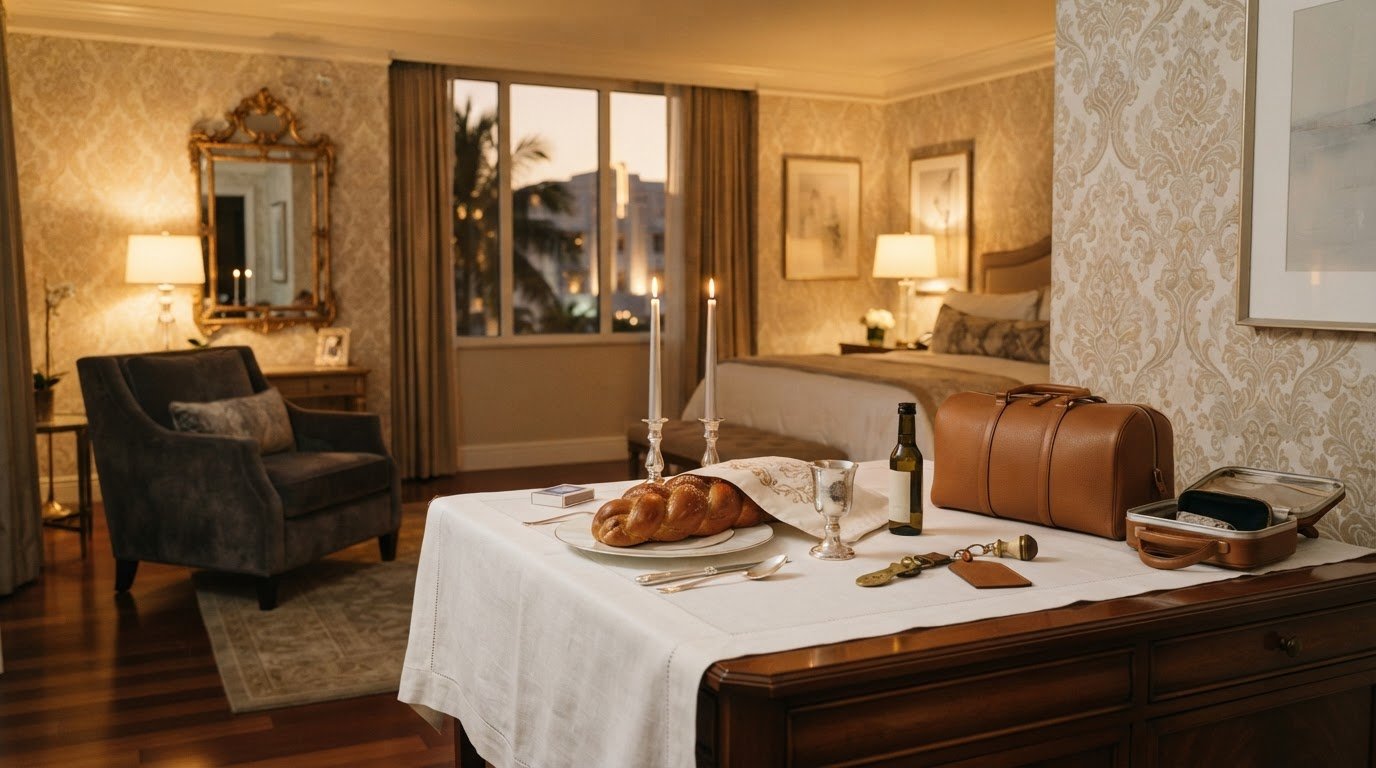
A kosher label alone doesn’t tell you whether a hotel will have a synagogue or minyan during your stay. Arrangements can depend on the season and occupancy. A luxury hotel with flexible checkout for Shabbat should also make departure timing clear, including whether you can stay after Shabbat ends and how your luggage will be handled. These details shape the stay as much as the room itself.
It’s natural to want Shabbos to feel peaceful from arrival through departure, without last-minute uncertainty about keys, meals, prayer, or checkout. A little advance planning can help you identify the arrangements that matter most for your observance and travel plans.
This guide covers four essentials: Shabbos amenities in the room and around the hotel, synagogue and minyan access, standard hotel timing, and late checkout after Shabbat. You’ll know what to consider when choosing a stay in the United States and how each detail can help make the weekend feel more comfortable and considered.
Key Takeaways
- Review room access, lighting, lifts, meals and luggage arrangements as part of your Shabbos needs, not as minor hotel details.
- Plan around the hotel’s stated check-in and checkout times; standard checkout may fall before Shabbat has ended.
- Post-Shabbat late checkout is a separate arrangement, shaped by hotel policy and room occupancy, with luggage storage as another practical consideration.
- A kosher setting doesn’t by itself mean there will be a synagogue or minyan during your stay; consider nearby prayer options and walking routes too.
- Compare the timing and observance arrangements for your specific stay before choosing a hotel, since Shabbat accommodations can vary.
1. Hotel amenities for Shabbos guests
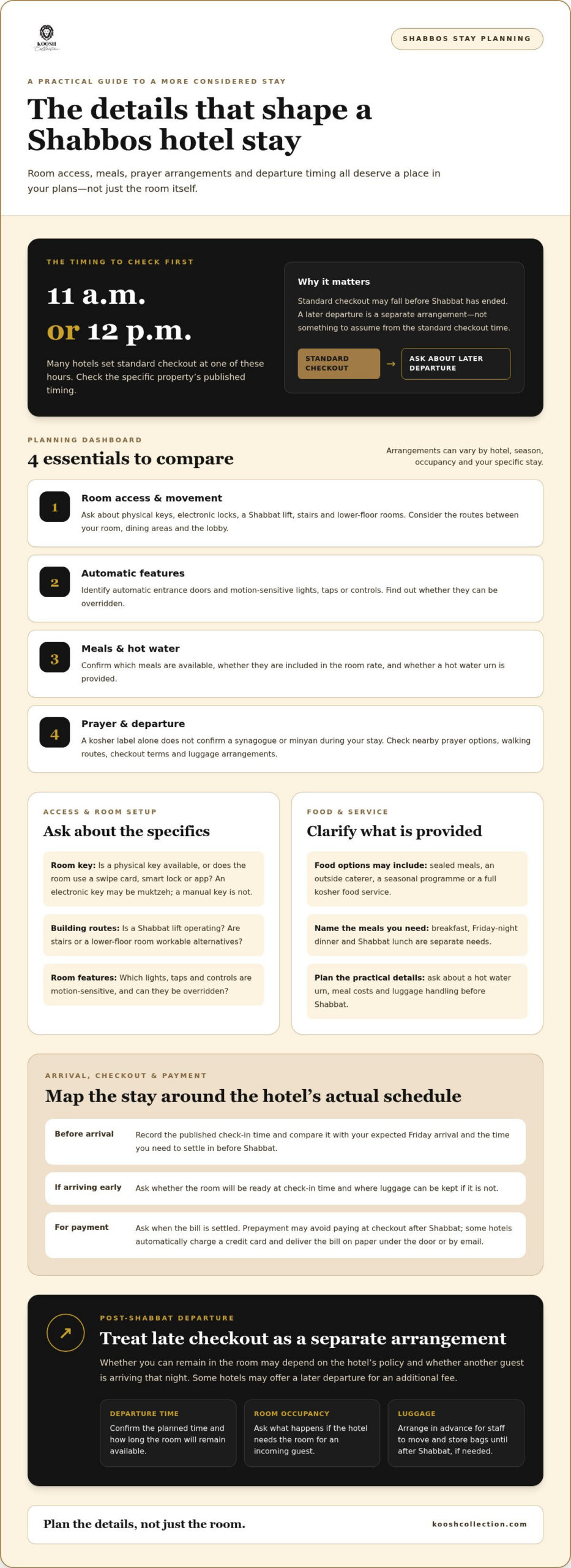
Room access is one of the first practical details to consider. Find out whether the door uses a physical key, swipe card, smart lock, or app. An electronic hotel key may be muktzeh, while a manual key is not muktzeh and can be carried to the front desk. That distinction can affect how you plan to enter and leave your room throughout Shabbat.
Movement through the building matters, too. Find out whether a Shabbat lift operates and whether stairs or a lower-floor room offer a workable alternative. Lift arrangements can affect access to guest rooms, dining areas, and the lobby, so consider the routes you expect to use. A lower floor may suit guests who prefer stairs, while a Shabbat lift may be important for guests who cannot comfortably use them.
Pay close attention to automatic features. Entrance doors may open automatically, while motion sensors can control lights, taps, or other room features. Find out which controls work this way and whether they can be overridden. A motion-sensitive bathroom light, for instance, may affect routine room use. Understanding the specific setup helps you plan for the features you’ll encounter, rather than relying on the general label “Shabbat-friendly.”
- Ask whether a physical room key is available and whether the door also uses an app or electronic lock.
- Ask about a Shabbat lift, stair access, and the possibility of a lower-floor room.
- Identify automatic doors and motion-sensitive lights, taps, or controls, including any available overrides.
- Ask whether hot water urns are provided for Shabbat use.
- Clarify which Shabbat meals are provided and whether they’re included in the room rate.
Meal arrangements can differ even at hotels offering kosher food. Options might include sealed meals, an outside caterer, a seasonal programme, or a full kosher food service. Find out which applies to your travel dates, then clarify which meals are available. Breakfast, Friday-night dinner, and Shabbat lunch are separate needs, so specify which meals matter to your plans.
Consider room and service details together. A hot water urn, meal arrangements, and room access each address a different need. If you’ll need staff to move your luggage before Shabbat and store it until afterward, arrange that in advance. A clear list of access, lighting, meals, and luggage needs makes it easier to compare Shabbos amenities and plan a comfortable stay.
2. Hotel check-in and checkout times
Hotel timing can shape a Shabbat stay before you reach the lobby. Many hotels set standard checkout at 11 a.m. or 12 p.m., while arrival times follow each property’s policy. Compare those hours with your Friday arrival, the start of Shabbat, and your planned departure. A midday checkout may work for an ordinary weekend but leave little room after Shabbat ends.
Check the property’s published arrival and departure times rather than assuming every hotel follows the same schedule. The stated check-in time sets the baseline for when you can access your room. For a Friday arrival, compare that time with your travel plans and the time needed to unpack, settle in, and prepare for Shabbat. A later arrival can leave less time for those tasks.
Plan your booking around your arrival day. If you expect to reach the hotel on Friday, consider how much time you’ll have to settle in before Shabbat begins. For an earlier arrival, find out whether the room will be ready at the stated check-in time, and plan a separate place for your luggage if needed. If your arrival is delayed, keeping essential items accessible rather than packed away may help.
Before reserving, write down the timing details that affect your plans:
- Record the hotel’s check-in time and your expected Friday arrival.
- Note the standard checkout hour, especially if it falls before Shabbat ends.
- Compare your booking dates with your intended Shabbat stay and departure day.
- Identify when you’ll settle the bill and how the hotel handles final charges.
Payment timing is part of the schedule. Guests can prepay a bill to avoid paying at checkout after Shabbat. Many hotels automatically charge the guest’s credit card and may deliver the bill on paper under the door or by email. Decide which arrangement suits your observance and travel plans before arrival. This can reduce the need to handle payment during departure.
Keep standard checkout distinct from a request to remain later. The listed checkout time is the baseline for planning; any extension is a separate arrangement, covered in the next section. Review the Koosh Collection details as you map out arrival and departure timing. A simple written schedule helps align travel, room access, meals, and payment without rushing the transition into Shabbat.
3. Late checkout after Shabbat
Late checkout after Shabbat is separate from the hotel’s standard departure time. Some hotels may let guests stay in their rooms beyond checkout when nobody else is arriving that night. Others may offer a later departure for an additional fee. Room occupancy and the hotel’s policy for that date are key factors.
A luxury hotel with flexible checkout for Shabbat can make departure easier, but “flexible” needs a practical definition. Establish the planned departure time, whether the room will remain available until then, and what happens if the hotel needs it for an incoming guest. Luggage storage is a separate matter: guests can arrange for staff to move bags and hold them until after Shabbat.
For a stay near a synagogue or kosher dining, choose a luxury hotel whose location suits your walking plans and whose post-Shabbat departure terms fit your schedule. A kosher designation alone doesn’t establish that a hotel has an on-site minyan or offers late checkout. Treat location, prayer arrangements, dining, and departure timing as separate parts of the decision.
If the hotel can’t extend checkout until after Shabbat, arrange luggage storage and collect your bags later, or reserve the room through the following night and leave at the standard checkout time. This gives you a clear alternative to packing and departing before Shabbat ends. Plan transportation around the departure time you’ll actually use.
Before settling on a departure plan, put these details together:
- Set the latest time you need to leave the room after Shabbat.
- Determine whether you’ll keep the room or store luggage until collection.
- Coordinate the collection time with your transport and onward plans.
- Keep the hotel’s standard checkout time separate from any later arrangement.
Occupancy can shape the answer. A room with no incoming guest that night may be easier to retain than one scheduled for another arrival. Seasonal demand and the hotel’s operating circumstances can also affect late departure. Make your request in advance so you have time to build a workable alternative if the room must be vacated.
Include payment in your plan. Prepaying can avoid handling the bill at checkout after Shabbat. Hotels may automatically charge a credit card and send a paper bill under the door or by email. Choose the arrangement that fits your observance, then align luggage, room access, and transportation with the same departure plan.
The best choice is the hotel whose location and timing suit your Shabbat stay. Consider synagogue access and kosher dining alongside the room’s departure arrangements, rather than assuming one feature guarantees another. A clear plan for the room, luggage, payment, and onward travel can make the transition after Shabbat more composed.
4. Shabbos weekend retreat
A Shabbos retreat depends on more than a room and meal plan. Prayer arrangements, synagogue access, and the route between them shape the weekend. An on-site minyan may depend on season or occupancy, so availability can differ between stays at the same hotel. A kosher designation alone doesn’t mean a minyan will take place during your visit.
Consider both on-site prayer and nearby options. If a synagogue is within walking distance, assess the actual route from the hotel entrance, not just the distance shown on a map. A route with difficult crossings or an inconvenient entrance, for example, may not suit your needs. Consider who is walking, how far they’re comfortable going, and which services they plan to attend.
The local eruv is another practical factor for guests who need one. Eruv arrangements can change or be suspended, so current status comes from the relevant local Jewish community. Treat this as separate from synagogue proximity: a hotel may be close to a synagogue, while the eruv’s status and the route remain distinct considerations.
Before choosing a weekend, map the essentials together:
- Identify whether prayer is planned on-site or at a nearby synagogue.
- Consider how season and hotel occupancy may affect minyan arrangements.
- Assess the walking route to synagogue for your group’s practical needs.
- Use the relevant local Jewish community for current eruv information.
Shape the retreat around how your group will use the property. A family attending services may value a straightforward route, while guests planning to stay on-site may prioritize available prayer arrangements. If several people are travelling together, discuss mobility and walking preferences before booking. This makes the choice more personal than relying on a hotel label alone.
Keep the entire Shabbos schedule in view. Prayer location, meals, room access, and departure plans all affect how the weekend flows. A nearby synagogue may suit your plans only if the route works for your group and the service schedule aligns with your stay. Planning these details together helps you choose a retreat setting that supports observance without assuming every hotel offers the same arrangements.
A well-matched Shabbos weekend comes down to practical fit: the right prayer option, a workable walking route, and relevant local information. Season and occupancy can shape minyan availability, while local eruv arrangements may change. Treat each as a separate planning detail, and let your group’s dates and needs guide the decision.
5. Are Shabbat checkout accommodations guaranteed or subject to availability?
Late checkout after Shabbat isn’t standard at every hotel. It depends on the property’s policy and whether another guest is due to arrive in your room that night. If the room is needed for an incoming reservation, the hotel may require you to leave at its usual checkout time. A Shabbat-friendly description alone doesn’t promise an extended stay.
Room occupancy is central. A hotel with no same-night arrival for your room might let you stay later, sometimes without an additional charge. A room assigned to incoming guests presents a different situation. Late departure can also involve an additional fee, so understand the terms before building your travel plans around extra time.
Separate three arrangements that can sound similar: extending your room stay, storing luggage, and collecting stored bags after Shabbat. If you must vacate the room, luggage storage can still offer a practical alternative. Agree on where bags will be kept and when you can retrieve them. Then coordinate collection with your transportation and onward plans.
Use a simple planning sequence to avoid relying on assumptions:
- Compare the standard checkout time with when Shabbat ends for your stay.
- Establish whether a later room departure is available and the relevant terms.
- Arrange luggage storage if you’ll leave the room before collecting your bags.
- Plan transportation around the departure or luggage collection time.
A written reservation detail or booking message can help keep the plan clear. Save the agreed departure time and luggage arrangement with your itinerary. If you’re travelling with family, share the plan so everyone knows whether to pack before Shabbat or leave bags ready for storage. Treat the standard checkout time as the baseline until a later departure is arranged.
Flexibility also depends on the timing of your visit. The next reservation for your room can affect the hotel’s ability to extend your stay, even if a similar request worked on another date. Evaluate a luxury hotel with flexible checkout for Shabbat by its actual departure arrangement, not just its general description. Build a backup around luggage storage and transport rather than assuming the room will remain available.
For your upcoming getaway, review hotel details with Koosh Collection and plan your Shabbat stay alongside your departure needs. The most useful comparison is straightforward: standard checkout, any later room access, luggage collection, and onward transportation. Keeping those details together lets you make a considered choice and plan a calmer transition after Shabbat.
Koosh Collection: hollywood florida hotels
Koosh Collection offers hotels in Hollywood, Florida, for travelers planning a refined South Florida stay with kosher and Shabbat considerations in mind. Its collection includes Dolce by Wyndham Hollywood, providing a starting point for exploring hotel options in the area. Use the practical details in this guide to shape your priorities: room access, meals, prayer arrangements, and departure timing. These needs can help you decide which questions matter most for your dates and travel plans.
For travelers seeking a kosher hotel in Florida or a luxury stay, Koosh Collection offers Dolce by Wyndham Hollywood, with year-round Kosher amenities. Explore the property and plan your stay around your priorities.
Shape a Shabbat stay around what matters most
Your next step is to turn your priorities into a stay plan. Decide what matters most for your group, then use those preferences to guide your hotel choice and travel dates. The right luxury hotel with flexible checkout for Shabbat is one that suits your observance and the kind of weekend you want to create.
Koosh Collection offers luxury hotel accommodations, including Dolce by Wyndham Hollywood and its year-round Kosher amenities. Explore the property details with your Shabbat plans in mind, and identify the arrangements that will help you make a comfortable, considered decision.
Contact Koosh Collection to plan your stay, and take the next step toward a Shabbat weekend shaped around your needs.
Frequently Asked Questions
What Should You Check Before Booking a Kosher Hotel?
Find out what “kosher” means for the specific stay, including meal arrangements and which meals are served. Options may include sealed meals, outside catering, a seasonal programme, or full kosher food service. Also consider whether room access and building facilities suit your Shabbat observance. A group with different mobility needs may prioritize elevator access, while guests planning communal prayer may focus on nearby synagogue arrangements.
Which luxury hotels offer late checkout for Shabbat in the United States?
Late checkout policies are set by individual hotels, so there isn’t one nationwide list that applies to every stay. The hotel’s location, room occupancy, and reservation dates shape the arrangement. Compare properties by the departure terms for your specific booking, not by their luxury or kosher labels alone. A hotel’s kosher services describe dining arrangements, not necessarily its checkout policy.
Which luxury hotels have Shabbat-friendly checkout policies or flexible checkout times?
Look for hotels that explain Shabbat departure arrangements separately from standard checkout. A useful policy should clarify whether guests can remain in the room after Shabbat, how luggage is handled, and whether an extension carries a fee. “Shabbat-friendly” can describe different services at different properties, so assess the actual departure terms. Keep a written record of the agreed checkout plan with your reservation details.
Can hotel guests request checkout after Shabbat ends, and how far in advance?
Guests can request post-Shabbat checkout, and the most practical time to raise it is while arranging the reservation. This gives you time to plan around the hotel’s standard departure, room occupancy, and onward travel. There’s no universal advance-request deadline across hotels. Include your requested departure time and luggage needs in the conversation, then keep the agreed details so your travel companions can plan around them.
Do luxury hotels charge extra for late checkout after Shabbat?
Some hotels may allow a later departure without an extra charge, while others may charge to extend room use. The room’s next reservation and the hotel’s occupancy can affect the arrangement. Find out what applies to your booking and whether the terms differ between keeping the room and storing luggage. Don’t assume complimentary luggage storage also means you can remain in the room later.
Which hotels provide Shabbat elevators, key-free room access, or other Shabbat accommodations?
Amenities vary by property. Hotels in New York City often provide physical keys and hot water urns for Shabbat, but that pattern doesn’t establish what another hotel offers. For access, distinguish a manual key from an electronic card, app, or smart lock. Also consider whether elevator arrangements and automatic features suit your observance. An amenities list is more useful when it describes the exact room and building setup.
What should guests ask a hotel before booking a Shabbat stay?
Ask about the details that shape your itinerary: meal service, room access, building facilities, prayer arrangements, and departure options. A family arriving Friday may need to understand how meal service fits its plans, while a guest departing after Shabbat may need separate room and luggage arrangements. Share your travel dates and priorities together so each answer can be considered in the context of your full stay.