
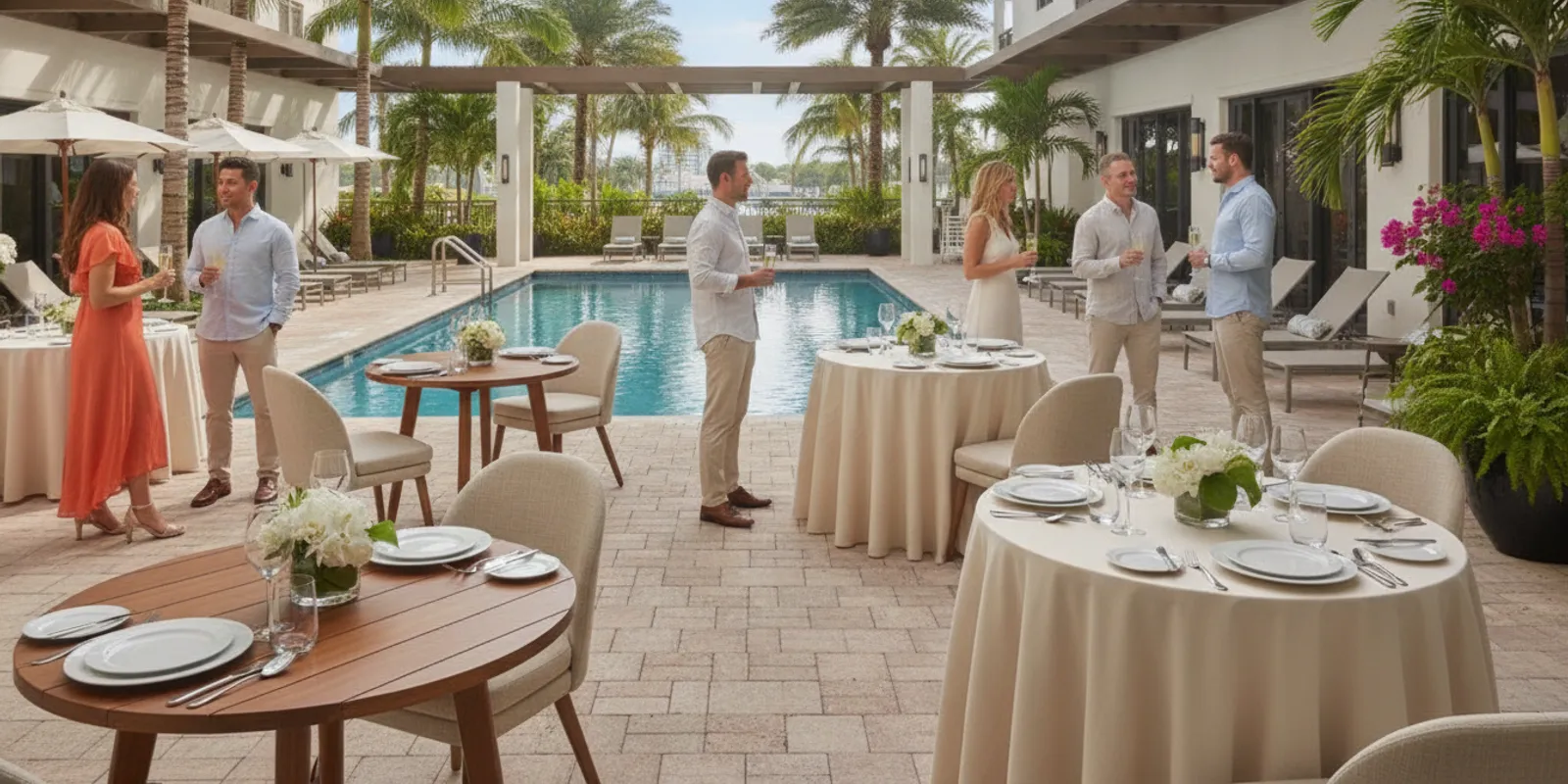
A fort lauderdale hotel pool party venue can sound like an easy way to bring guests together, but the best choice depends on more than a poolside setting. Before you invite people, map the event from arrival through departure and confirm exactly what the property can provide for your date. This guide focuses on the questions that help hosts compare a hotel pool setting without assuming that an advertised amenity automatically means private event access.
Explore current booking options
What should a hotel pool party venue help you plan?
A pool party combines a social gathering with a shared amenity. That makes it different from reserving a dining room or meeting room. Guests may arrive at different times, move between seating and the water, need a place to keep personal items, and ask where they can change or find the restroom. The host has to consider the whole experience, not just the view beside the pool.
Start by writing a short event brief. Include the preferred date and time window, the reason for gathering, a realistic guest estimate, the age range, whether guests intend to swim, and any food or accessibility needs. You do not need a detailed production plan to make an initial inquiry. A clear outline helps the property tell you which details it can confirm and which need follow-up.
For a hotel event, separate four questions that are easy to blur together:
- Is the pool available for the requested use? An outdoor pool amenity does not, by itself, confirm permission to hold a party there.
- What space is included? Ask whether the proposed area is a pool deck, a reserved seating zone, an adjacent room, or another location.
- Who else may use the area? Ask whether regular hotel guests retain access during the event.
- What services are actually offered? Confirm food, furniture, setup, staffing, and cleanup rather than treating them as included by default.
Barley House is Koosh Collection’s Fort Lauderdale boutique hotel, marketed near the beach and with a courtyard pool. Its Barley House pool party page is a useful property-specific starting point. Still, a page about a pool party is not a substitute for a date-specific confirmation of event use, availability, access, or terms. Ask the property directly before describing the gathering to guests as confirmed.
How should you map guest flow?
Guest flow is the route people take through the event. A simple map can reveal bottlenecks before they happen. Think about where guests arrive, where they check in or meet the host, where they put bags, where food is served, how they reach seating, and how they move around the pool without crossing a serving line or blocking a walkway.
Ask the venue to describe the proposed layout in practical terms. Which entrance should guests use? Is there a designated gathering point? Where can a rideshare stop, and where should a guest who drives ask about parking? Which areas remain open to hotel guests? Do guests need to pass through a lobby or another public space to reach the pool? Do not assume that a route or entrance used by hotel guests is the right route for an event group.
For a small gathering, a compact seating arrangement may be enough. A larger or more active group needs deliberate separation between conversation, food service, and the pool edge. Ask where the host can place a welcome point without obstructing circulation. If children will attend, ask whether the proposed seating lets responsible adults keep an appropriate view of the pool area. Do not treat furniture placement as a replacement for active supervision.
Use these questions to test a proposed layout:
- Can guests enter and leave without walking through the serving area?
- Is there a clear route to restrooms and any agreed changing area?
- Can guests who are not swimming sit comfortably away from splashes?
- Is there space for mobility devices and a route that does not rely on steps? Ask staff what access is available rather than guessing from photos.
- Where will gifts, personal belongings, or event supplies go, and who is responsible for them?
- Does the plan leave hotel circulation and pool access unobstructed?
Share the guest-flow questions early, not the day before the event. The venue may need to confirm with its operations team whether the requested arrangement works. If it cannot provide a diagram, ask for a written description of the proposed area and the guest route so you can communicate accurate instructions.
What should you ask about pool access and privacy?
“Poolside” can describe many different arrangements. A group might have reserved tables near a pool while other guests continue to use it. A pool area might be unavailable for private use. A property might permit an event in a nearby space but not allow party guests to swim. These are distinct arrangements, so ask which one applies rather than relying on a general label.
Use precise questions: Is the pool itself part of the event, or only the surrounding area? Can event guests swim? Is access limited to registered hotel guests, event attendees, or both? Is any part of the area reserved exclusively, and for what hours? How will staff identify invited guests? Are there limits on decorations, music, photography, or outside vendors? Ask whether the venue can put the agreed access and privacy terms in writing.
Privacy can mean different things to different hosts. You may want a quiet corner, a defined seating area, or an entirely private gathering. State what matters to you. Do not promise guests exclusive use, a secluded setting, or a private pool unless the property confirms that specific arrangement. If hotel guests will share the area, ask how that affects the event layout, sound level, and movement through the space.
Also ask about the practical boundaries of the event. Can guests bring decorations? Are balloons, candles, amplified sound, or outside entertainment allowed? Are there quiet hours or other operating rules? Is photography permitted, and are there restrictions on capturing other guests? A short written list of permitted and prohibited items can prevent awkward conversations during setup.
Barley House’s hotel information can help you understand the property context, while the Barley House private events page provides another route for an event inquiry. Neither should be read as proof of pool access, a private pool arrangement, or a particular package for your requested date. Treat those as questions to resolve with the property.
How can you plan for Fort Lauderdale weather?
An outdoor gathering needs a weather plan even when the forecast looks favorable. Rain, wind, heat, lightning, or changing conditions can affect comfort and safety. The right backup depends on what the hotel can offer, so do not assume there is an indoor alternative or that an outdoor event will simply move inside.
Ask what happens if weather makes the planned area unsuitable. Is there an alternate location? Is it available for the same time? Would the alternate space accommodate the expected group and activity? Who makes the decision to move or pause the event, and when will that decision be made? If there is no indoor backup, ask what options are available for rescheduling or changing the plan. Confirm any applicable terms directly; do not infer a cancellation or refund policy.
Think through guest comfort as well as rain. Ask what shade is available, whether seating can be arranged away from direct sun, and whether guests may bring approved sun protection. Ask if water is available and how service works. For a daytime party, give guests a realistic note about outdoor conditions and clothing once the property has confirmed the plan. Avoid promising covered seating, cooling equipment, or a weather guarantee unless those details are agreed.
Prepare a simple decision tree with the venue. For example: continue outdoors if the conditions meet the property’s operating guidance; pause or relocate only if an approved alternative has been confirmed; contact guests using one designated channel if the timing or location changes. The property should clarify its own procedures. Your role is to know the contact path and to avoid making a last-minute decision based only on what looks comfortable to one person.
Weather planning also includes the event schedule. Leave a little flexibility around arrival and food service so a short delay does not disrupt the whole gathering. If guests are traveling from elsewhere, send the confirmed address, arrival instructions, and the update contact in advance. Koosh Collection’s Barley House trip-planning page may be useful when preparing general property and destination details, but verify event-specific directions with the hotel.
What food and beverage details should you confirm?
Food planning starts with what is permitted, not with a menu assumption. Ask whether the venue offers food or beverage service for the event, whether service is available poolside, and what the process is for getting a current menu or proposal. Confirm who handles ordering, when final choices are due, how service is delivered, and what happens if the guest count changes.
If you hope to bring outside food, ask first. Check whether outside food is allowed, whether there are restrictions on delivery, setup, serving equipment, or cleanup, and whether the venue requires advance approval. Do not arrange a caterer until the property’s rules and access requirements are clear. If you have dietary needs, describe them specifically and ask what the venue can confirm. A general statement about dining at a hotel does not guarantee that a particular item, preparation method, or service is available for a pool event.
For a kosher-observant gathering, use especially precise language. Koosh Collection’s available certification information is venue-specific: it names G7 Hospitality LLC at the rooftop address in Hollywood and does not certify the Barley House pool, the hotel as a whole, or every dining operation in the portfolio. Do not infer that a pool party at Barley House has kosher catering or that any meal meets a guest’s requirements. Ask the property what, if anything, can be arranged for the date, and let guests make their own decisions based on the confirmed details.
Useful food and beverage questions include:
- What service, if any, is available in the proposed event area?
- Can the host review a current menu and the full terms before committing?
- Are nonalcoholic beverages available, and how are they served?
- What is the policy on outside food, cake, or a specialty caterer?
- Can the venue address allergies or dietary requests, and what information can it confirm?
- Who will coordinate delivery, setup, replenishment, and removal?
- What is the deadline for final guest numbers and selections?
Record the answers in writing, including any service fees, minimums, taxes, or other costs if the property provides them. Do not publish or circulate a price from an old message or an informal conversation as a current quote. For the portfolio’s general dining context, see Koosh Collection dining information; contact the relevant property to verify whether a particular option applies to your event.
What safety questions belong in the first inquiry?
Pool safety needs to be discussed before an invitation goes out. Ask the property to explain its pool rules, whether swimming is permitted during the proposed event, and what supervision or staffing the venue provides. Do not assume that event staff are lifeguards, that a lifeguard will be present, or that the host may delegate supervision to hotel employees. Ask exactly what the property does and what remains the host’s responsibility.
If children may attend, plan for a responsible adult to supervise each child according to the family’s needs and the property’s rules. Ask where adults can sit while maintaining an appropriate view, whether children have to be accompanied in the pool area, and what age-related rules apply. Share those expectations with parents before the event. A poolside party invitation should not imply that children can swim without adult oversight.
Ask about emergency procedures in plain terms. Who should the host contact if someone needs help? Where is the nearest staff member or designated assistance point? What should guests do if an alarm or weather instruction is given? Ask whether there are rules for glass, running, diving, noise, or other conduct around the pool. Follow the venue’s directions and make sure your event plan does not block routes or interfere with normal property operations.
Check how the setup affects safety. Avoid placing food, decorations, cords, or personal items where they could create a trip hazard or obstruct circulation. Ask what materials are allowed near the water and whether the property will inspect or approve the layout. If guests will be moving between the pool and a social area, make the route easy to understand and keep it clear.
Finally, establish one host as the point person. That person can communicate venue instructions, check in with staff, and respond to questions without asking multiple guests to interpret rules. This is especially helpful when the group includes children, older adults, or people with different mobility needs. Clarify the property’s emergency and accessibility procedures directly rather than relying on an online photograph or a general description.
How do you compare a hotel pool setting with other event spaces?
A pool setting can suit a casual, social gathering, but it is not automatically the best format for every event. Compare the experience you want with the practical requirements of the group. A poolside arrangement may offer an outdoor atmosphere but require weather planning, explicit swimming rules, and a way to keep belongings and food away from wet areas. A dedicated event room may make service and seating more straightforward, but may not deliver the same outdoor feel.
Use a comparison table as a discussion tool, not as a statement of what any property provides. Fill in the right-hand column only after receiving a date-specific response.
| Question to compare | Poolside gathering | Indoor or other event area |
|---|---|---|
| Guest access | Confirm whether guests can use the pool and whether hotel guests share the area. | Confirm the exact room or area, access times, and any shared-use conditions. |
| Weather exposure | Ask what happens during rain, wind, heat, or other unsuitable conditions. | Ask whether the space is available for the requested time and what alternatives exist. |
| Food service | Confirm service location, outside-food rules, and setup limits. | Confirm service arrangements, furniture, and any room-specific restrictions. |
| Guest movement | Map routes around the pool, seating, and serving area. | Map entrance, seating, restrooms, and any service area. |
| Privacy and sound | Ask what areas are reserved, who else may be present, and what sound rules apply. | Ask about room privacy, neighboring activities, and sound limits. |
| Safety and accessibility | Confirm pool rules, supervision expectations, and accessible routes. | Confirm the room’s access route, seating flexibility, and emergency procedures. |
Then rank what matters most. A host prioritizing swimming and outdoor conversation may prefer a poolside setting if access is confirmed. A group needing structured presentations, weather certainty, or quiet conversation may want to ask about a different space. Do not choose based on a single appealing photo. Make the decision using the actual area, event terms, and operating conditions that the venue confirms.
Koosh Collection describes event options across its portfolio, but each property and space has its own status and terms. The private events overview can help you find a general inquiry path. It is not a published quote or a guarantee that a pool area is reservable. Ask which property and venue your inquiry concerns, and keep the answer specific to that location.
What should you include in a venue inquiry?
A concise inquiry is easier to answer than a broad request for “a pool party package.” Use this checklist and ask the property to confirm each item for your date:
- Date and timing: Give a preferred date, a backup date if you have one, and the event’s expected start and end times. Ask how much setup and breakdown time is permitted.
- Guest estimate: Share the expected number of adults and children separately if relevant. Ask whether the estimate fits the proposed area, and whether any limit or layout condition applies.
- Event purpose and format: Explain whether guests plan to swim, eat, celebrate, or mainly socialize. Mention any planned entertainment or special setup.
- Space and access: Ask what exact area is being considered, whether use is exclusive or shared, and which amenities are included or remain unavailable.
- Food and beverages: Ask what can be ordered, what outside items are permitted, and what deadlines or service conditions apply.
- Weather and safety: Request the property’s weather procedure, pool rules, supervision expectations, and emergency contact path.
- Costs and terms: Ask for a written quote and all applicable terms. Confirm what is included and what could change the total, rather than relying on an assumed package.
- Next step: Ask who will confirm availability and how to secure the arrangement if you decide to proceed.
Keep a record of the response. A helpful event summary might state the requested date, the confirmed area, access rules, guest estimate, service arrangements, weather alternative, and the person responsible for follow-up. If any item remains unknown, label it as pending instead of filling the gap with a guess.
For Barley House-specific questions, the property has a rooms information page and a separate pool-party reference. The collection’s main contact page is another way to ask which team can address an event request. Clarify that you are asking about the Fort Lauderdale property and pool-area event use so your request is routed appropriately.
How should you set expectations with guests?
Wait until the venue confirms the important details before sending a polished invitation. If you need to send a save-the-date earlier, describe the location and activity as tentative. Do not promise pool access, private use, food, a weather backup, or a specific event length until those terms are confirmed.
Once the plan is clear, send practical information in one message: the correct property name and address, arrival instructions supplied by the venue, start and end times, what guests should bring, any pool or dress rules, and a contact for day-of changes. If food is included or guests may bring something, state only what the hotel has approved. For children, communicate the supervision plan directly to parents.
Give guests a way to tell you about accessibility or dietary needs early. You can then ask the venue whether it can accommodate a request. Do not tell a guest that an accommodation is available until you have confirmation. The same care applies to kosher dietary needs: relay only the specific information the relevant food provider has verified for the event, rather than making a broad claim about the property.
Make the invitation clear about what is not included too. If guests will pay for their own food, if swimming is not confirmed, or if the gathering may move because of weather, say so in a calm and direct way. Accurate expectations help guests decide whether the event works for them and reduce confusion on arrival.
How do you decide without overplanning?
Use a simple three-part test. First, confirm the venue can accommodate your preferred date and the type of gathering you have in mind. Second, verify the essentials: access, guest flow, weather response, food rules, privacy, and safety. Third, decide whether the confirmed arrangement still fits your group and budget. If a critical point remains unresolved, ask one focused follow-up before you commit.
You do not need to solve every decorative detail in the first conversation. Start with the questions that could change the location or the event format. Once the property confirms the area and terms, make a short plan for arrival, seating, service, communication, and cleanup. That approach keeps the process manageable while protecting you from making promises that the venue has not made.
Ask about private event options
Frequently asked questions
Does a hotel pool automatically mean I can host a party there?
No. A pool listed as a hotel amenity does not confirm that parties are allowed, that event guests can swim, or that any area can be reserved. Ask the property to confirm event use, access, hours, and applicable rules for your date.
Can I assume the pool area will be private?
No. Ask whether the area is exclusive or shared with hotel guests, what part of the space is reserved, and how access is managed. Do not describe an event as private unless the property confirms that arrangement.
What if it rains or conditions are unsuitable?
Ask whether an alternate location is available and what the property does if outdoor conditions change. Confirm any move, rescheduling, or other terms in writing. Do not assume there is an indoor backup.
Can I bring my own food or caterer?
That depends on the property’s rules and the event arrangement. Ask about outside food, deliveries, caterers, setup, and cleanup before placing an order or making a commitment to guests.
What is the best first step for a Barley House pool party inquiry?
Send the property your preferred date, time, expected guest count, and a short description of whether guests plan to swim. Then ask for written confirmation of pool access, the event area, weather options, food rules, safety expectations, and all applicable terms before you invite guests.
A successful pool gathering starts with a clear conversation and realistic expectations. Confirm the details with the property, then build an event plan around what is actually available for your date.