

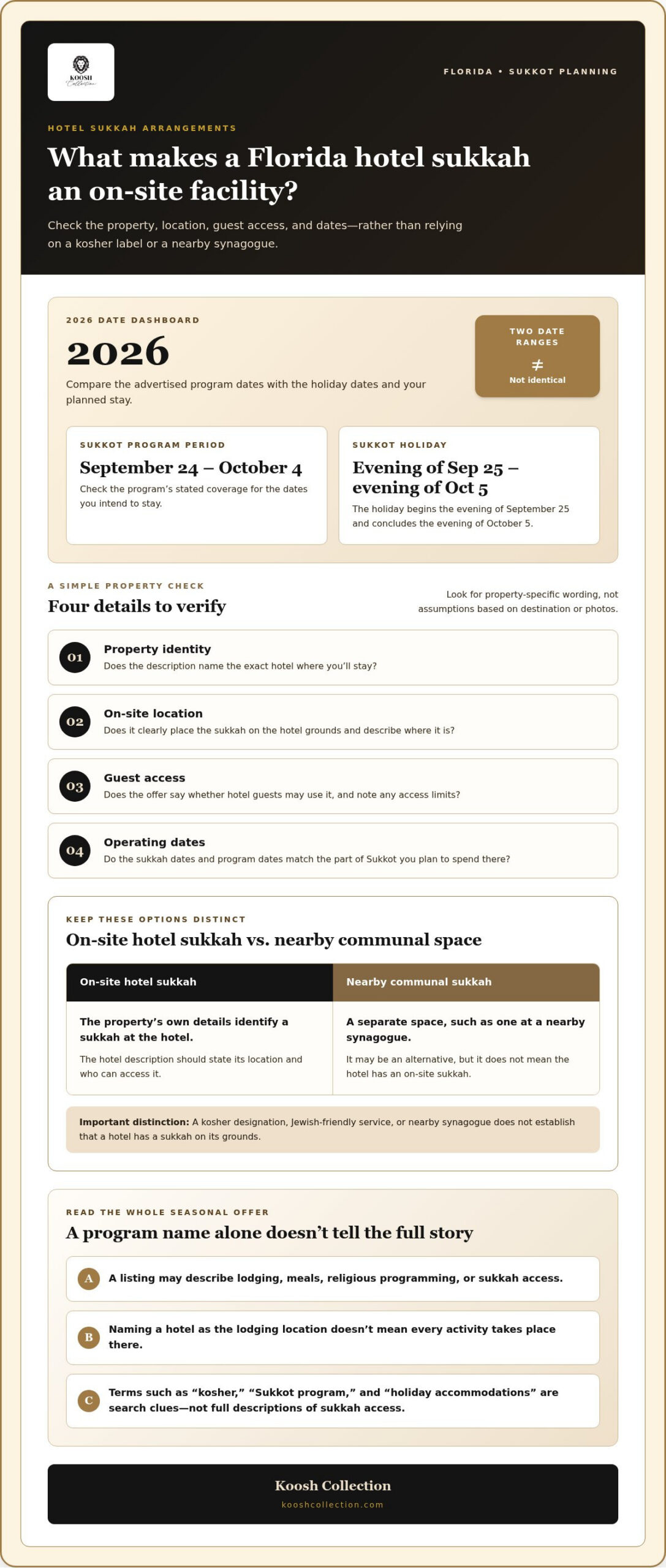
The 2026 Sukkot program period is September 24 through October 4; Sukkot begins the evening of September 25 and concludes the evening of October 5. For a hotel with a sukkah on site, those dates are the starting point for planning your stay with Koosh Collection.
A hotel with a sukkah on site can make holiday meals and time outdoors easier to plan. Booking windows and minimum stays vary by property and program, so check the terms for the specific option you’re considering.
This guide explains how to assess on-site sukkah arrangements, compare stay details, and distinguish hotel facilities from nearby communal spaces. Use these criteria to shape a Sukkot trip that fits your plans.
Key Takeaways
- Compare Florida hotel options by location and the kind of Sukkot arrangements they describe, not just by the presence of a sukkah.
- Plan your stay around the holiday dates and each property’s booking terms; minimum-night requirements can vary.
- In Miami Beach and Surfside, consider how nearby synagogues and communal sukkahs fit your plans alongside hotel amenities.
- Look for details about sukkah access, opening times, and guest use to understand how the space may fit into your stay.
- For a Hollywood, Florida stay, explore kosher hotel options as part of your search for holiday accommodations.
Which hotels in Florida have an on-site sukkah?
A Florida hotel qualifies as having an on-site sukkah only when its own Sukkot arrangements identify a sukkah at the property. A kosher designation, Jewish-friendly service, or nearby synagogue does not establish that the hotel has one. Look for a property-specific description that states where the sukkah is and who can access it. This separates an on-site facility from a communal sukkah elsewhere.
For 2026, the Sukkot program period runs September 24 through October 4. Sukkot begins the evening of Friday, September 25, and concludes the evening of Monday, October 5. Those dates aren’t identical, so compare the advertised program period with your intended arrival and departure. A listing that mentions a holiday program may cover only its stated dates.
Florida searches may center on coastal areas, larger cities, or resort destinations. Use the destination as a starting point, not proof of a hotel sukkah. A hotel close to a synagogue might offer convenient access to communal facilities, but that differs from having a sukkah on-site. The distinction matters if you want to reach the sukkah without traveling beyond the hotel grounds.
Build a shortlist using hotel pages or seasonal program descriptions that name the property and describe its sukkah. Compare the stated location and access arrangements. A rooftop, courtyard, or dining-area sukkah can shape how easily it fits your plans, but rely on the property’s description rather than assuming its location. The key question is not only whether a sukkah exists, but whether its stated arrangements suit how you plan to use it.
- Property identity: Match the sukkah description to the exact hotel, not just a destination or hotel group.
- Location: Look for a clear indication that the sukkah is on the hotel grounds.
- Guest access: Find out whether hotel guests may use it and whether access has stated limits.
- Dates: Compare the sukkah’s operating dates with your planned stay and the 2026 holiday calendar.
An outdoor sukkah’s location can affect how it fits into your daily plans. A terrace, courtyard, or garden may require a different walk from guest rooms or dining spaces. Consider how often you expect to use it and whether the hotel clearly describes its location. The property’s details are more useful than assumptions based on photos or broad amenity descriptions.
When looking for a hotel with an on-site sukkah in Florida, use the hotel’s own seasonal description as your deciding evidence. If your preferred hotel does not provide an on-site space, a nearby synagogue or communal sukkah may be an alternative. Keep the options distinct as you compare locations, so your shortlist reflects the difference between staying at a hotel with a sukkah and staying near one.
Which Florida hotels offer a sukkah during Sukkot?
A Florida hotel offers a sukkah during Sukkot when its own property details or holiday program explicitly say so. A kosher label alone does not establish that the hotel has one, and neither does a nearby synagogue. Search the property name alongside a clear description of its Sukkot arrangements, then distinguish an on-site facility from a separate communal option.
Seasonal offers may be organized by a hotel or by a holiday program operating at a property. Descriptions can focus on lodging, meals, religious programming, or sukkah access. Read the offer as a whole: naming a hotel as the lodging location does not mean every program activity takes place there.
Use a simple comparison when reviewing Florida options:
- Property: Does the description identify the hotel where you’ll stay?
- Sukkah: Does it specifically say the sukkah is at that hotel?
- Guest use: Does the offer describe access for hotel guests?
- Program dates: Do the stated dates cover the part of Sukkot you plan to spend there?
These details distinguish a hotel with an on-site sukkah from one merely near a sukkah. An offer that mentions a communal sukkah at a synagogue describes a nearby resource, not a hotel facility. A hotel page that places a sukkah on its grounds describes an on-site arrangement. Keep the options separate when comparing locations and stay plans.
Florida hotel listings may use terms such as “kosher,” “Sukkot program,” or “holiday accommodations.” Treat these as search clues, not complete descriptions of sukkah access. A kosher hotel may focus on dining, while a seasonal program may include activities beyond lodging. Look for specific wording about the sukkah instead of inferring details from the hotel’s broader identity.
Program structure can affect which property suits your trip. One arrangement may center on hotel lodging, while another may organize meals or holiday activities at a separate location. The practical question is how your room, the sukkah, and the program activities relate to one another. A clear property description shows whether they share a site or involve separate places.
For a focused search, pair a Florida destination with terms such as “Sukkot hotel program” and “hotel sukkah.” Compare results by property name, sukkah location, guest access, and program dates. Keep a short record of each hotel’s wording. This makes it easier to spot when listings refer to the same holiday program rather than separate hotel options.
Match the offer to the way you plan to observe Sukkot. If convenient sukkah access is central, prioritize a property that explicitly places one on-site and describes guest use. If a nearby communal space works for your itinerary, compare that option separately. The right Florida hotel is the one whose stated arrangements fit your location and holiday plans.
Sukkot in 2025 begins at sundown on October 6, 2025, and ends at nightfall on October 13. Use that period to check whether a hotel’s stated sukkah access and holiday arrangements match the dates of your stay. A listing that mentions Sukkot without specifying when the sukkah is available may leave an important detail unresolved, so ask the property or program organizer to confirm the schedule directly.
Before booking, clarify whether the sukkah is on the hotel grounds, who may use it, and whether access requires participation in a separate program. Make sure the details apply to your chosen property and stay, not another venue connected with the offer. If the listing is unclear, request a written description of the location and access arrangements. These checks help you compare lodging options without treating a kosher dining offer, nearby communal facility, or general holiday program as proof of an on-site sukkah. Keep the confirmation with your travel plans so you can refer to the specific arrangement.
Are there hotels with sukkahs in Miami Beach or Surfside, Florida?
Compare on-site and nearby options separately. A hotel qualifies as an on-site sukkah option only when its own description places the sukkah at the property. A nearby synagogue or communal sukkah may suit your plans, but it is not a hotel facility.
Start with the hotel’s exact name and address, then compare them with the location named in any Sukkot program. A program may advertise lodging in one place and holiday activities elsewhere. Matching names and addresses helps establish whether the sukkah is at your hotel, at a program venue, or elsewhere in the community.
Search by hotel name using terms such as “Sukkot sukkah,” “hotel sukkah,” and “holiday program.” Review the hotel’s seasonal description alongside any program details. Focus on where guests stay, where the sukkah is, and who may use it. A broad “kosher” description does not answer those location questions.
- Hotel property: Record the hotel’s stated address and the sukkah location separately.
- Search area: Apply the same comparison to each destination, even when a program serves both.
- Communal option: Note whether a synagogue or shared sukkah is the actual destination.
- Guest access: Identify whether the arrangement is described for hotel guests.
These details matter when planning how you’ll get around during the holiday. One traveler may prefer a sukkah within the hotel grounds, while another may plan around a communal sukkah elsewhere. The better fit depends on the locations of your room, the sukkah, and any meals or gatherings in your itinerary.
Map the hotel and each holiday destination before choosing an area. A map can show whether a sukkah is on the hotel property or at a separate address. Consider the route you expect to take on foot or by other transport. The map helps establish geography; the hotel’s description establishes what the property provides.
Keep a comparison note for each option with the hotel name, address, sukkah address, access details, and program dates. If a listing says “near” or “community” rather than “on-site,” record that distinction. This simple method helps prevent mistaking a nearby synagogue for a hotel amenity.
When choosing between search areas, start with the setting that best fits your travel plans. Then compare the specific sukkah arrangements rather than assuming both areas offer the same hotel experience. A description that clearly connects the property, sukkah, and guest access gives you the best basis for deciding whether the location suits your Sukkot plans.
How can I confirm a hotel sukkah is available and open to guests
Use the hotel’s own description to distinguish an on-site sukkah from a nearby communal space. Then match its access details to your stay dates. For Sukkot 2026, the program period runs September 24 through October 4, while the holiday concludes the evening of October 5. A program’s dates and the holiday dates may differ, so compare both before planning.
Start with the hotel’s exact name and property address. A seasonal page may describe lodging in one place and activities in another. Look for wording that connects the sukkah to the hotel grounds, not just a mention of a synagogue or community sukkah. If the sukkah has a listed address, compare it with the hotel address. Different addresses indicate separate locations.
Next, establish who can use the space. “Sukkah available” does not explain whether access is for hotel guests, program participants, or the wider community. Look for a description of eligibility and any stated access arrangements. It should also explain whether the sukkah is intended for meals, gatherings, or another use. These details show how well the facility fits your itinerary.
Use this checklist to assess the wording:
- Location: Does the description place the sukkah on the hotel property?
- Guests: Does it say hotel guests can use the space?
- Dates: Does access cover your arrival and departure dates?
- Hours: Are opening times or access periods described?
- Use: Does the description explain the intended purpose?
Booking details provide another useful cross-check. A hotel reservation may cover room nights without including a separate holiday program. A program description, in turn, may outline activities without explaining how to book a room. Keep the lodging confirmation and sukkah information together. Compare the property name, dates, and access details across both documents to spot differences between the stay and program.
For a 2026 stay, note that Sukkot begins the evening of Friday, September 25, and concludes the evening of Monday, October 5. If a hotel’s program ends October 4, that end date doesn’t itself describe access on October 5. Record the exact dates shown for the room, the program, and the sukkah. Clear date matching helps you understand which parts of your planned stay each arrangement covers.
Keep a concise record for each property: hotel name, sukkah location, guest access, operating dates, hours, and any stated limits. For example, “on hotel grounds, guest access, dates listed” is more useful than “Sukkot offered.” If the published description leaves a practical question unanswered, get a direct response from the hotel before relying on that detail.
Once you’ve compared the sukkah arrangements, consider which hotel location best fits your travel plans. Explore hotel accommodations as you shape your stay.
Koosh Collection: hollywood florida hotels
Koosh Collection offers hotels in Hollywood, Florida, for travelers considering a stay near the area’s attractions. Its hospitality options include kosher hotel accommodations in Hollywood, making the collection relevant when location and kosher lodging are central to your plans.
If Hollywood fits your Florida itinerary, compare the hotel’s location with your preferred Sukkot arrangements, including any synagogue or communal sukkah you plan to use. A hotel stay and access to a sukkah are separate considerations; assess each against your needs.
For travelers weighing Hollywood as their base, Koosh Collection offers a focused place to explore local hotel accommodations. Contact Koosh Collection to discuss a Hollywood, Florida stay.
Shape a Stay Around What Matters Most
Build your stay around the experience you want, not simply a room in a preferred city. Decide whether an on-site sukkah is essential or whether a nearby communal space can work for your plans. Then choose a location that fits the rest of your Sukkot itinerary. This makes your search for a hotel with a sukkah on site in Florida more focused.
If Hollywood suits your travel plans, explore Koosh Collection’s hotels there, featuring exceptional year-round Kosher amenities. Consider how the hotel’s location and kosher offerings fit alongside your holiday arrangements. Assess access to a sukkah separately, using the property’s stated details to determine whether it meets your needs.
Explore the Hollywood hotel and take the next step toward a stay shaped around your plans.
Frequently Asked Questions
What are the nightly rates and minimum stays at Florida hotels with sukkahs?
Nightly rates and minimum stays vary by hotel, dates, room type, and whether you book a Sukkot program alongside the room. Compare lodging terms with any separate program details, since they may cover different dates or inclusions. Use the hotel’s quoted rate and stated minimum stay for your itinerary rather than relying on a general Florida-wide figure.
Do hotels with sukkahs require advance reservations or special arrangements?
Reserve lodging ahead and arrange any holiday program separately if it uses a different booking process. Include your arrival and departure dates, number of guests, and whether you need access to the hotel sukkah. A room reservation alone may not include meals or other program activities. Keep the reservation and program details together so your itinerary reflects the arrangements you intend to use.
Which Florida hotels with sukkahs are near synagogues or Jewish communities?
Start with the Florida community you plan to visit, then compare hotel and synagogue addresses to assess proximity. Miami Beach, Surfside, and Hollywood are distinct search areas, so narrow your hotel search to the area that fits your itinerary. A hotel’s kosher focus does not establish its distance from a synagogue. Map the route to your intended destination and distinguish an on-site sukkah from a community sukkah.