
A luxury label can signal an elevated stay, but it does not tell you whether a hotel suits your observance or community plans. When searching for a luxury hotel near jewish community, assess community access, the hotel’s stated amenities, and hospitality credentials as separate considerations.
That distinction matters. “Jewish-friendly” can mean different things to different travelers, while kosher amenities and proximity to community life are practical questions with personal answers. A welcoming description or a hotel’s reputation cannot define what is right for your trip.
This guide offers practical criteria for weighing those priorities, understanding what year-round Kosher amenities communicate, and considering luxury credentials in context. Koosh Collection provides a clear example of curating stays that balance upscale hospitality with community needs. Use the details that matter to you to decide whether a stay fits your plans.
Key Takeaways
- Assess community access separately from a hotel’s stated amenities, then weigh both against your itinerary and personal priorities.
- When comparing a luxury hotel near jewish community florida, use specific criteria rather than relying on broad labels like “Jewish-friendly.”
- Read star ratings, hospitality designations, and kosher descriptions as distinct signals. Each answers a different question.
- Rank your essential needs before comparing hotel descriptions, so the details that matter most guide your decision.
- Koosh Collection offers refined luxury accommodations with year-round kosher amenities. Its premier hospitality standards reflect exceptional service and attention to detail.
What to look for in a luxury hotel near a Jewish community
A luxury label can suggest an elevated experience, but it may leave practical questions unanswered. The phrase “Jewish-friendly” can sound reassuring without explaining what a hotel provides, how its location fits your plans, or whether its stated features align with your needs.
Separate the decision into three parts: community access, the hotel’s stated features, and your personal priorities. A luxury hotel near jewish community florida should be assessed by how these factors fit your trip, not by a broad label alone. Access depends on location and your itinerary; kosher amenities are hotel features. Neither establishes the other.
A community-conscious luxury stay brings personal observance, community plans, and clearly described hotel amenities into one thoughtful decision. That leaves room for different needs while keeping the evaluation grounded in details rather than assumptions. For historical context on Jewish community life and development, explore this overview of Jewish history.
What does Jewish-friendly hospitality mean?
The phrase can describe different levels of consideration. One traveler may mean a welcoming atmosphere, while another may be looking for specific food standards or religious services. These are not interchangeable. Treat a broad description as a starting point, then review the hotel’s stated amenities and consider whether they address your priorities.
Why community access and hotel amenities are different
Community access is a location and itinerary question. Consider the routes you expect to take, the timing of your activities, and the transport arrangements that fit your plans. Hotel amenities are features the property describes as part of the stay. Assess each category on its own before weighing them together. The right balance depends on your observance, plans, and travel companions.
Start with the activities you expect to include. For example, a traveler planning community visits may prioritize route convenience, while another may place greater weight on the hotel’s stated kosher amenities. A family or group may need to balance several preferences. These are different ways to define a suitable stay, not one universal standard.
- Community access: Map the routes and timing relevant to your planned activities.
- Stated hotel features: Identify the amenities the property explicitly describes, including any year-round Kosher amenities.
- Personal priorities: Rank what matters most for your observance, itinerary, and travel companions.
Keep the categories distinct as you compare options. A convenient location does not establish a hotel’s food standards, and stated kosher amenities do not establish how accessible a community will be for your plans. Separating these questions helps you interpret descriptions accurately and choose a stay that fits your trip.
How to evaluate community access and kosher hospitality separately
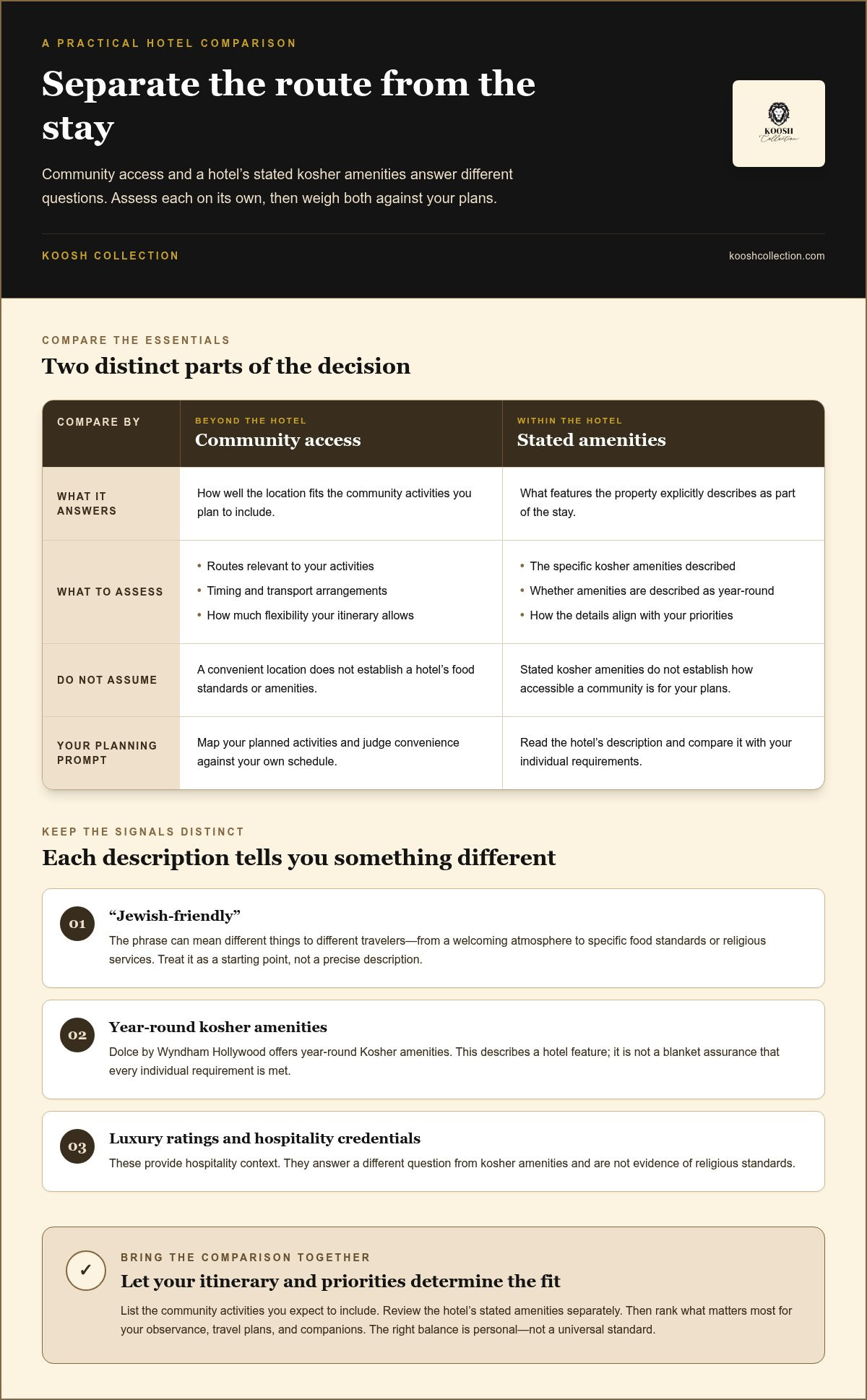
A useful comparison distinguishes the journey beyond the hotel from the experience within it. Community access depends on your itinerary, transport plans, and activities. Kosher hospitality should be evaluated through the hotel’s stated amenities. Put both on your planning list, but do not treat one as proof of the other.
Community access
- List the activities you hope to include, then map the routes that fit your schedule.
- Factor in your transport plans and how much flexibility your itinerary allows.
- Judge convenience against your own plans, not an assumed distance or a general label.
Stated hotel amenities
- Read descriptions of kosher amenities as information about that specific hotel.
- Note whether the amenities are described as year-round, then consider how that timing fits your trip.
- Keep hospitality credentials and religious standards distinct when reviewing descriptions.
Assessing community access for your itinerary
Begin with what you intend to do. List the community activities that matter during your stay, then consider the routes and transport arrangements that could shape your day. A location may suit one itinerary better than another. Evaluate that fit independently of the property’s amenities.
Understanding year-round Kosher amenities
Dolce by Wyndham Hollywood offers year-round Kosher amenities, a relevant hotel feature for observant travelers. The phrase describes an amenity, not a blanket assurance that every individual requirement is met. Compare the stated information with your own priorities and travel plans. For related planning context, explore this Shabbat-friendly stay guide.
To make the comparison practical, write down your priorities before weighing a luxury hotel near jewish community florida against your itinerary. You might rank community activities, transport considerations, year-round amenities, and hospitality standards in order of importance. The ranking is personal. Another traveler, even on the same trip, may make a different choice.
Luxury credentials add context, but they answer a different question from kosher amenities. For a reference point on how a travel guide frames hotel ratings, review the Forbes Travel Guide Rating System. Treat ratings as hospitality context, not evidence of religious standards. Location planning informs access, stated hotel details inform amenity expectations, and your priorities determine the fit.
For a closer look at the property’s stated details, consider Dolce by Wyndham Hollywood as one option in your comparison.
What luxury ratings and kosher descriptions can, and cannot, tell you
Hotel ratings, hospitality designations, and kosher descriptions each communicate different information. Read them for what they actually state instead of letting one credential stand in for every detail you care about. For travelers comparing a luxury hotel near jewish community florida, keeping these signals distinct makes the decision clearer.
Use this comparison to understand what each signal contributes:
| Signal | What it communicates | What it doesn’t establish |
|---|---|---|
| Star rating | A hospitality classification, such as a 4-star rating. | Specific religious services, kosher standards, or personal observance suitability. |
| Hospitality designation | A separate credential related to hospitality recognition. | Kosher certification or the details of a hotel’s religious amenities. |
| Stated kosher amenities | Features the hotel describes as kosher amenities, including whether they’re offered year-round. | That every guest’s individual requirements are met. |
Read across the rows rather than relying on one signal. A hotel can have a hospitality designation and stated kosher amenities, but those remain separate facts. Interpret each according to its wording and your own priorities.
What a four-star rating communicates
Dolce by Wyndham Hollywood is a 4-star luxury hotel. The rating provides a hospitality classification, not a description of specific amenities or religious services. A hotel rating describes hospitality; observance suitability depends on the stated features and your needs. This distinction helps prevent a general classification from being mistaken for information about kosher standards.
How to interpret a hospitality designation
Dolce by Wyndham Hollywood is an AAA Diamond Property. This is a hospitality credential, not kosher certification. Consider it alongside, not in place of, the hotel’s stated amenities. The designation and the property’s year-round Kosher amenities are separate details, each worth weighing against your priorities.
For each signal, ask what it tells you and what remains a separate consideration. A rating provides a hospitality classification; a designation offers its own hospitality context; a description of kosher amenities speaks to stated hotel features. None should be stretched to imply a particular religious service, community location, or standard that it does not name.
This approach is useful when a hotel description brings several polished terms together. Note the exact claim beside each term, then compare those claims with your priorities. “Year-round Kosher amenities” is meaningful as a stated feature without promising that every detail aligns with every traveler’s practice. The 4-star rating and AAA Diamond Property designation add hospitality context, but they do not replace religious information. Read each signal on its own terms, then assess the whole picture.
A practical checklist for comparing hotels against your needs
A useful shortlist starts with your priorities, not a star symbol or a polished phrase. Apply the same criteria to each option so you can see how its stated features fit the trip you plan to take.
Five steps to build a useful shortlist
- Rank your priorities. List the observance considerations, community activities, and comfort preferences that matter for this trip. Mark which are essential and which would enhance the stay. This keeps a broad promise from overshadowing what you value most.
- Plan community access independently. Consider your intended activities, transport arrangements, routes, and schedule. Assess how the location fits those plans using information relevant to your itinerary. Community access is a geographic planning question, not a hotel amenity or an automatic result of kosher amenities.
- Compare stated hotel features. Read each property’s description and match its specific wording to your ranked needs. If a description names year-round Kosher amenities, record that as a relevant hotel feature. Do not fill gaps with assumptions or treat a broad “Jewish-friendly” label as proof of a particular service.
- Review hospitality credentials separately. Record ratings and designations as distinct information. They can help frame your view of hospitality, but they do not replace stated amenity details or your assessment of observance suitability.
- Decide on overall fit. Compare the shortlist against your essential priorities first, then consider preferences that would make the stay more comfortable. The strongest match is the one that suits your plans, not necessarily the property with the most labels.
Matching hotel information to personal priorities
Travelers can weigh the same details differently. One may prioritize itinerary and routes; another may place more weight on stated kosher amenities or the style of the hotel. There is no universal ranking. A useful comparison makes your reasoning visible, so you can see which details support your plans and which remain separate considerations.
Accommodation is part of the decision, too. Review the available room information alongside your priorities, without assuming that a room description answers questions about community access or religious needs. Keep each detail in its proper place.
This framework leads to a closer look at a property’s stated facts. Dolce by Wyndham Hollywood is a 4-star luxury hotel with year-round Kosher amenities and an AAA Diamond Property designation. These details offer separate points of reference for travelers evaluating a luxury hotel near jewish community florida, without making a claim about specific community proximity.
Explore Dolce by Wyndham Hollywood’s hotel details as you compare your priorities with the property’s stated information.
A considered luxury stay with year-round Kosher amenities
Once you have set your priorities and separated location planning from hotel features, consider the property’s stated details on their own terms. Dolce by Wyndham Hollywood offers a clear point of reference: it is a 4-star luxury hotel with year-round Kosher amenities. These facts speak to hospitality classification and a relevant hotel feature, without assuming that every traveler has the same needs.
The confirmed details that matter to this search
The hotel’s 4-star rating and year-round Kosher amenities are distinct details to weigh against your checklist. Its AAA Diamond Property designation is a separate hospitality credential, not religious certification or a statement about kosher standards. Keeping those distinctions clear makes it easier to assess what each fact contributes to your decision.
For travelers seeking a luxury hotel near jewish community florida, this approach prevents one designation from answering a different question. Consider the 4-star rating in relation to your hospitality preferences and the year-round Kosher amenities in relation to your observance priorities. The AAA Diamond Property designation provides additional hospitality context. None of these details establishes community proximity, so assess your itinerary and location plans separately.
Specific wording matters. “Year-round Kosher amenities” communicates that the hotel offers kosher amenities throughout the year. It does not describe every detail of those amenities or establish that each guest’s individual requirements are met. Use the stated information as a comparison point, then consider how it aligns with the priorities you set for your stay.
The hotel amenities overview provides information about the property’s stated amenities. Read it alongside your checklist, rather than treating a general overview as a substitute for your personal assessment. This keeps your decision grounded in the available details and the priorities you have identified.
Taking the next step with confidence
Your comparison does not need a universal winner. It needs a clear connection between what matters to you and what the hotel states. If community access is central, use your plans to evaluate location and routes. If year-round Kosher amenities are a priority, consider that stated feature directly. Let hospitality credentials add context without assigning them meaning they do not carry.
Dolce by Wyndham Hollywood brings together a 4-star luxury hotel classification, year-round Kosher amenities, and an AAA Diamond Property designation. Each detail has a distinct role in your evaluation. Review the hotel information in the context of your priorities and decide whether the stated features suit your trip.
Choose the stay that fits your priorities
Turn your shortlist into a choice by keeping your essential needs visible as you review each property. Let the details that matter to you carry more weight than broad labels. The right fit is the stay that supports your plans while offering the level of hospitality you value.
For comparison, Dolce by Wyndham Hollywood brings together a 4-star luxury hotel experience, year-round Kosher amenities, and an AAA Diamond Property designation. Consider each as a distinct detail while deciding whether the hotel aligns with your priorities for a luxury hotel near jewish community florida.
Review the property information with your checklist in mind. A thoughtful choice begins with knowing what matters most, then finding a stay whose stated details speak to those needs. Explore the Dolce by Wyndham Hollywood stay and take the next step toward a stay chosen with confidence.
Frequently Asked Questions
Is a hotel near a Jewish community automatically kosher?
No. Being near a Jewish community does not automatically make a hotel kosher. Community access may make planned activities more workable, but it does not establish a property’s food standards. When searching for a luxury hotel near jewish community florida, assess location and travel plans separately from the hotel’s stated kosher amenities. If your observance depends on a particular standard, do not infer it from an address, rating, or welcoming description.
Does a four-star hotel rating mean the hotel is kosher-certified?
No. A four-star rating describes a hotel’s hospitality classification, not kosher certification or specific religious services. Dolce by Wyndham Hollywood is a 4-star luxury hotel and offers year-round Kosher amenities. These are separate details, and one does not establish the other. For your comparison, note the rating as hospitality information and assess the stated amenities against the requirements that shape your trip.
What does year-round Kosher amenities mean for a hotel stay?
It means the hotel describes its Kosher amenities as available throughout the year. At Dolce by Wyndham Hollywood, year-round Kosher amenities are a stated property feature. The phrase alone does not specify meals, certification, supervision, or facilities, so avoid reading more into it than it says. Compare the stated feature with your observance priorities and consider how relevant it is to your planned stay.
Is Jewish-friendly hospitality the same as kosher hospitality?
Not necessarily. “Jewish-friendly” is a broad phrase that may describe a welcoming approach, while kosher hospitality refers to stated kosher-related amenities or food considerations. The wording alone does not guarantee a particular service. A warm welcome and a stated kosher amenity are different kinds of information. Look for specific descriptions and assess them independently rather than relying on one general label.
Does an AAA Diamond designation confirm kosher standards?
No. An AAA Diamond Property designation is a hospitality credential, not a statement of kosher certification. Dolce by Wyndham Hollywood holds the AAA Diamond Property designation and separately offers year-round Kosher amenities. Read those as distinct facts: the designation gives hospitality context, while the amenities describe a hotel feature. Neither should be used to make assumptions about the scope of the other.
How can travelers compare community access with hotel amenities?
Start with the activities and practical needs that matter during your trip. Sketch your expected schedule and transport plans, then consider how community access fits those plans. Separately, compare hotel amenities using only the features the property states. This can help you decide which factors deserve the most weight, especially when traveling with companions whose schedules or observance priorities differ from your own.