
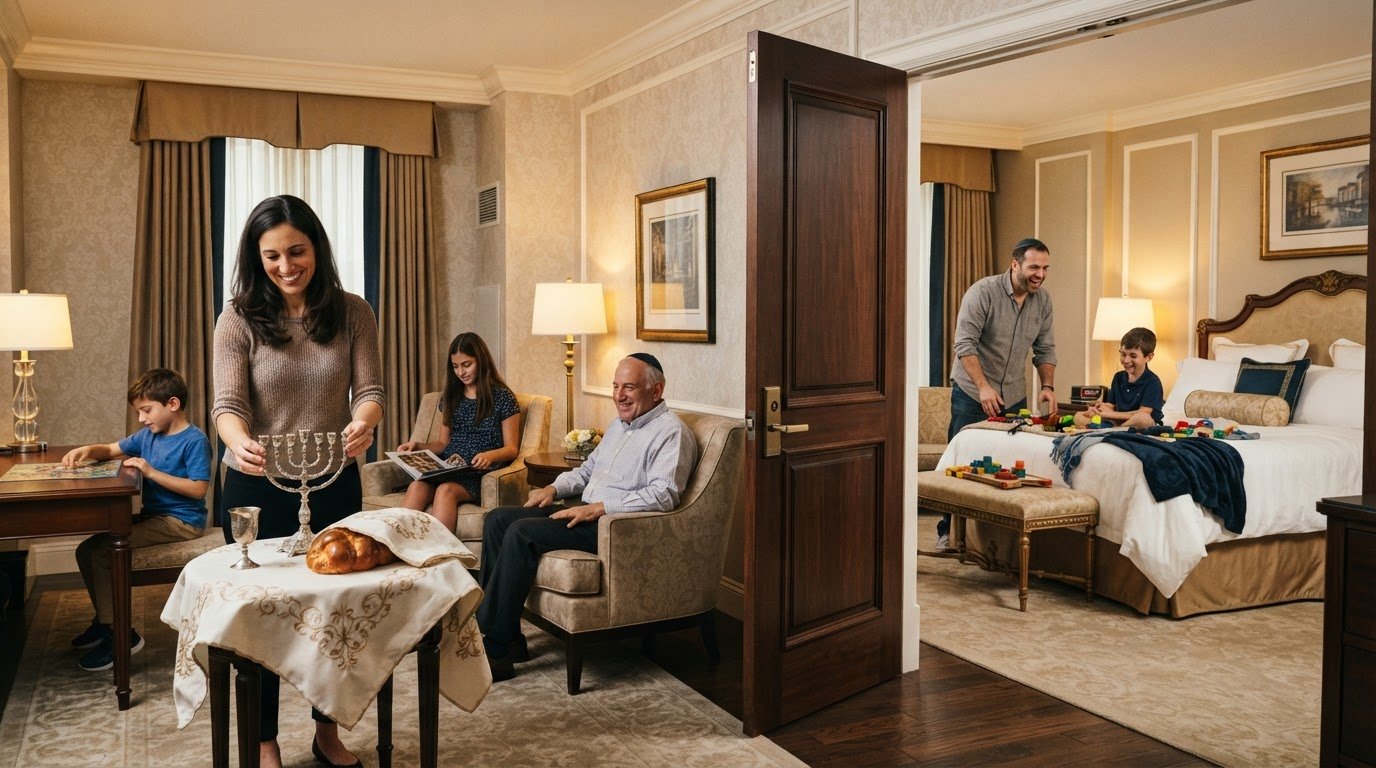
What if the rooms you booked for Shabbat are close together, but not connected? That small distinction can shape the whole stay. Booking adjoining rooms for Shabbat takes more than adding a preference to a reservation. You need to know whether the rooms share an interior door and whether the property can confirm that setup for your dates.
It’s natural to want family close by, with enough space for everyone to settle in. But “adjoining” may mean rooms next to each other, while “connecting” usually means rooms with a shared interior door. A request added to a booking may not guarantee either arrangement.
This guide explains how to describe the layout you need, ask for written confirmation, and check the practical Shabbat arrangements that matter to your family. You’ll find questions to ask about room access and placement, plus ways to follow up when a configuration is only a request. With clear priorities, you can compare options and understand what still needs confirmation before you book.
Key Takeaways
- For booking adjoining rooms for shabbat, describe the layout your family needs rather than relying on hotel terminology alone.
- Room labels can vary. Ask whether there’s a shared interior door or simply a nearby room.
- Consider children’s ages, privacy, group size, and mobility when weighing different room arrangements.
- Share your dates, party size, room count, and exact connection request, then ask for written confirmation and reconfirm before arrival.
- Check Shabbat-related arrangements directly with the property, including any details your family needs to verify before booking.
Booking Adjoining Rooms for Shabbat: Start with Your Family’s Needs
Family proximity matters, as does a room setup that supports the way your household observes Shabbat. Before comparing room categories or sending a request, decide what the rooms need to do. This guide focuses on arranging rooms near one another without assuming that every property uses “adjoining” to describe the same layout.
Start with your group: who’s travelling, how many rooms you need, and whether children or anyone with accessibility needs affects your preferred arrangement. Then consider which Shabbat routines could influence room placement, movement between rooms, or the timing of interactions with hotel staff. The meaning and observance of Shabbat varies, so make your request around your household’s needs rather than another traveler’s preferred setup.
What does adjoining rooms mean when you book?
Room labels aren’t always consistent. “Connecting rooms” commonly refers to rooms with a shared interior door. “Adjoining rooms” may mean rooms next to each other without that door. Rooms described as nearby or on the same floor may be separated by a hallway or other rooms. Ask the property to explain its terminology and confirm the physical layout you’re requesting.
Map the group’s Shabbat and room requirements
Make a short list before you browse. Note who is travelling, children’s ages, room capacity, accessibility considerations, and how close together the rooms need to be. Identify which Shabbat routines affect your family’s movement, preferred room placement, or scheduling. A nearby room may work well for one household, while another may need an interior connection. Don’t assume another family’s priorities will suit yours.
Keep the request specific but allow for alternatives. Decide whether your priority is a shared interior door or simply rooms close together, and whether both rooms need to be on the same floor. These details help the property understand what you’re asking for, while leaving room to discuss other arrangements if the preferred layout can’t be confirmed.
Four checks before you compare rooms:
- Layout: Is there a shared interior door, or are rooms simply nearby?
- Capacity: Will the room count and sleeping arrangements suit everyone?
- Shabbat needs: Which routines affect placement, movement, or scheduling?
- Written confirmation: What specific arrangement can the property confirm for your dates?
Once you’ve defined those priorities, review the available room information as a starting point. Then ask the property to clarify details that matter to your family. A clear request helps the property understand what to check, but the exact layout and any Shabbat-related arrangements still need direct confirmation.
Adjoining vs. Connecting Rooms: Which Layout Works for Shabbat?
The distinction can affect how easily family members move between rooms. In general usage, connecting rooms share an interior door, while adjoining rooms may simply sit next to each other. Hotel descriptions aren’t consistent, so treat these labels as a starting point for questions, not as confirmation of a particular layout.
| Room arrangement | What to ask the property | Possible fit |
|---|---|---|
| Connecting rooms | Is there a shared interior door, and can it be locked? | May suit families who want to move between separate rooms without using the hallway. |
| Adjoining rooms | Are the rooms next to each other, and is there an interior door? | May offer close proximity, but the term alone doesn’t confirm a connection. |
| Separate nearby rooms | How close are the rooms, and can their locations be requested? | May work when being on the same floor or nearby is enough. |
When an internal connecting door matters
A shared door can make it easier for relatives to move between rooms while keeping separate sleeping spaces and privacy. Ask whether the door is lockable from both sides and how access works. If children need supervision or a traveler has mobility needs, consider whether the connection would make movement simpler. The property must confirm the exact layout for the specific rooms booked.
When nearby rooms may be enough
Rooms on the same floor or close together may suit a group that values proximity but doesn’t need an interior doorway. Ask how far apart the rooms might be, whether they’re in the same corridor, and whether you can request their location. A request is not a confirmed allocation, so clarify what the property can verify for your dates.
Privacy matters, too. One household may prefer a connecting door for easy visits; another may value separate entrances and a little more distance. For booking adjoining rooms for shabbat, weigh the needs of the whole group, including children’s ages and accessibility, rather than relying on a room label alone. For broader Shabbat-related hotel considerations, consult STAR-K’s halachic guide to hotels.
Review the available room configurations as an initial reference, then confirm specific layouts directly with the property. You can also explore the featured property and ask whether its room arrangements and Shabbat details fit your plans.
Compare Shabbat Room Arrangements Without Making Assumptions
The right layout depends on how your family will use the rooms, not just how a booking page labels them. A connecting door can make movement between rooms easier, while separate nearby rooms may offer more privacy. Neither arrangement is automatically right for every Shabbat stay.
- Connecting rooms: A shared interior door may help family members move between separate rooms. Ask how the door works and whether it can be secured.
- Adjoining rooms without a door: Rooms may be close together while still requiring guests to use the hallway. Confirm the distance and location.
- Separate nearby rooms: These may suit guests who only need rooms in the same general area, but “nearby” can mean different things to different properties.
Hotel terminology varies, so treat each description as something to verify. Keep confirmed details separate from preferences. “The property confirmed a shared interior door” is different from “we requested rooms near each other.” A request or room description alone doesn’t establish the exact allocation for your stay.
Questions that reveal whether a layout fits
Start with who needs to move between rooms, how often, and whether an interior door is essential. Consider the children’s ages, whether adults need separate sleeping spaces, the capacity of each room, and any mobility needs. A larger group may prioritize capacity; a household seeking more privacy may prefer separate entrances. Shabbat observance is personal, too. Identify your household’s routines rather than assuming one arrangement works for everyone.
What to confirm about Shabbat arrangements
Ask the property about the specific arrangements your household requires, and request clear answers about what can be confirmed for your reservation. Don’t assume a room layout also addresses your Shabbat needs. Policies and features can vary, so another guest’s experience is not confirmation for your booking.
For individual halachic questions, consult a trusted religious authority. For wider planning considerations, Koosh Collection’s The Art of the Observant Stay may offer useful context. Use that guidance to prepare your questions, then confirm relevant room and Shabbat details directly with the property before booking. Your preferences help shape the request; the property’s response establishes what it can confirm.
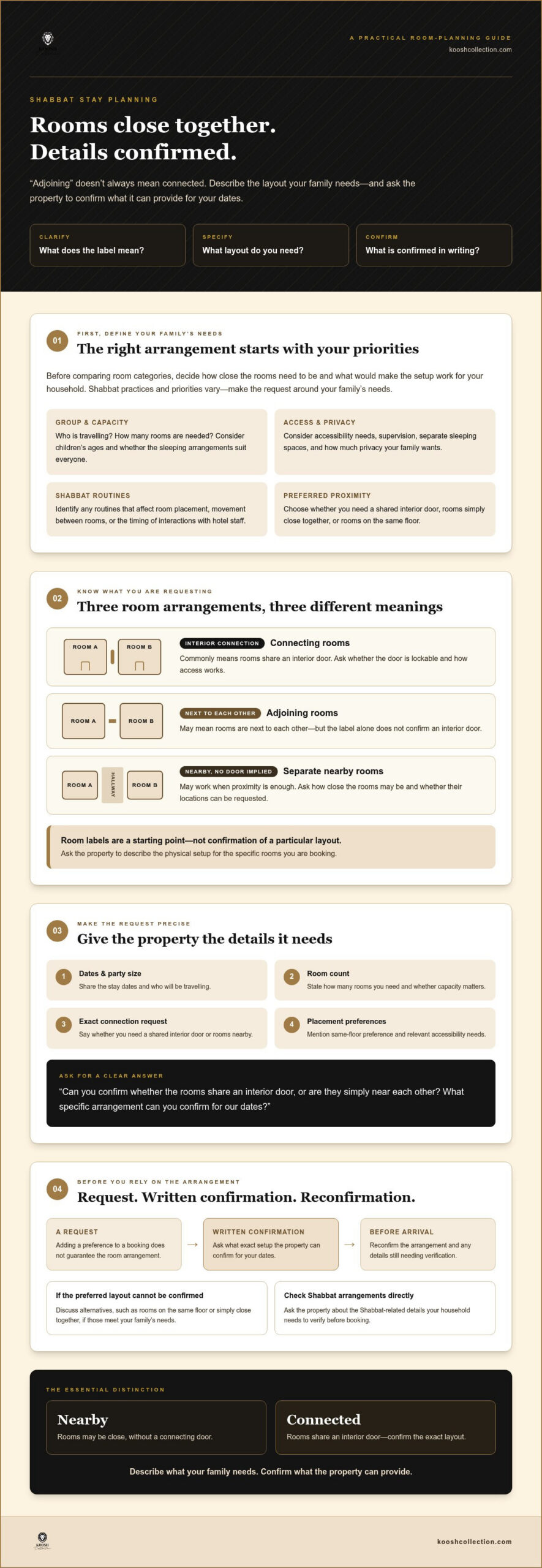
How to Request and Confirm Adjoining Rooms for Shabbat
A clear request gives the property something specific to check. For booking adjoining rooms for shabbat, describe the layout your family needs, then distinguish what the property has confirmed from what it has only noted as a preference.
- Define your needs. Decide whether you require rooms with a shared interior door or would accept rooms close together. Note who needs access between rooms, how many separate sleeping spaces you need, and any accessibility considerations.
- Check the room descriptions. Review the wording, but don’t rely on labels such as “adjoining” or “nearby” to establish a layout. If the description isn’t specific, ask the property what the rooms share and how they’re positioned.
- Contact the property with the details. Include your stay dates, party size, number of rooms, occupancy needs, and exact connection requested. State plainly any Shabbat-related arrangements your household wants to discuss. Ask what can be accommodated rather than assuming a request can be fulfilled.
- Document the response. Request written confirmation of the room configuration and any agreed arrangements. Ask directly: “Is this configuration confirmed for my reservation, or has the request only been added as a preference?” Keep the reply with your booking details.
- Reconfirm before arrival. Check the details again before your stay, especially if the reservation or room arrangements have changed. If the configuration can’t be guaranteed, decide whether the alternative offered still works for your family.
Make the request precise
For example, say whether an interior connecting door is essential or whether rooms on the same floor could work. Include the required room count, who will stay in each room, and relevant accessibility needs. Describe Shabbat considerations in practical terms, such as the room access or scheduling details your family needs to discuss, and ask which details the property can confirm for your reservation.
Keep confirmation current
A note on a reservation may record your preference without confirming the final layout. Ask for the property’s answer in writing, and follow up if you receive only a general acknowledgment. After any booking change, verify that the room request and agreed details still appear in the updated reservation.
To assess whether the featured property may suit your plans, review the hotel and ask about room configurations and Shabbat arrangements directly. Availability and specific provisions need confirmation for your dates.
Choose a Shabbat Stay That Fits, and Take the Next Step
The best choice is the layout that suits your group, followed by direct confirmation of the room setup and any Shabbat arrangements you need. A label on a booking page is only a starting point. Before committing, find out whether the rooms connect internally, are simply close together, or have another arrangement altogether.
For booking adjoining rooms for shabbat, separate confirmed details from requests. Koosh Collection focuses on upscale hospitality and offers kosher-friendly and Shabbat-friendly hotel services. The room configuration and any specific Shabbat-related provisions still need to be verified for your dates and reservation.
A final booking checklist for adjoining rooms
- Confirm how the property defines the room type, and whether a shared interior door is essential.
- Recheck the number of guests and rooms, occupancy needs, and how close together the rooms must be.
- Ask which Shabbat-related arrangements the property can confirm for your individual requirements.
- Keep written confirmation and reservation details accessible to the person managing the booking.
If the property can’t confirm your preferred configuration, pause and consider whether the alternative still works for your family. Nearby rooms may suit one group; another may need an interior connection to make the stay practical. Base your decision on the details the property confirms, not an assumption based on terminology.
Explore the featured hotel with the right questions
For broader preparation, review The Art of the Observant Stay for Shabbat-friendly stay planning, then bring your specific questions to the property. Ask about your dates, room configuration, and the individual arrangements your household requires. Keep the conversation precise, and request written confirmation of anything agreed.
Explore the room options and layouts as a starting point. If the featured hotel may suit your plans, review the featured hotel and inquire directly about your dates, requested room setup, and Shabbat needs. Availability and arrangements require confirmation.
Plan a Shabbat Stay with Confidence
A thoughtful booking begins with the layout your family needs. Connecting rooms may have an interior door, while adjoining or nearby rooms may simply be close together, so ask the property to clarify its terminology. Then confirm the room arrangement and any Shabbat-related details that matter to your household.
For booking adjoining rooms for shabbat, keep preferences distinct from confirmed arrangements. Share your dates, party size, room count, and exact connection request, and ask for the response in writing. Reconfirm if your reservation changes.
Koosh Collection focuses on upscale hospitality, including kosher-friendly and Shabbat-friendly hotel services. Specific room configurations and Shabbat arrangements still need to be confirmed directly. Explore the featured hotel and ask about your room requirements as you consider whether it fits your plans.
With clear questions and confirmation in hand, you can make a more informed choice and prepare for a stay that suits your family.
Frequently Asked Questions
How do I book adjoining rooms for Shabbat?
Tell the property what room arrangement your family needs, then ask what it can confirm for your dates. Include your stay dates, party size, room count, occupancy needs, and whether you require an interior connecting door or would accept rooms nearby. Ask whether the layout is confirmed or merely recorded as a preference, and request the response in writing. Reconfirm if your reservation changes.
Are adjoining rooms the same as connecting rooms?
No, not necessarily. “Connecting rooms” commonly describes rooms with a shared interior door, while “adjoining rooms” may simply be rooms next to each other. Hotels can use these terms differently, so don’t rely on the label alone. Ask whether there’s a door between the specific rooms, where they’re located, and whether guests can move between them without using a public hallway.
Can I guarantee adjoining rooms when I book a hotel?
Only if the property explicitly confirms that arrangement for your reservation. A request added to booking notes may be a preference, not a guarantee, and room descriptions don’t necessarily confirm a specific layout. Ask the property directly whether your requested configuration is secured for your dates. If it can’t confirm it, decide whether another arrangement would still meet your family’s needs before you finalize plans.
What should I ask a hotel about Shabbat arrangements?
Ask about the arrangements your household specifically requires, such as any room-access, lighting, or scheduling details relevant to your practice. Be clear and avoid assuming the property provides a particular service or feature. Ask what can be confirmed for your reservation and who at the property can clarify the details. For individual halachic questions, consult a trusted religious authority.
When should I request adjoining rooms for my family?
Make the request as soon as you know your dates and room needs, so the property can consider your preferences while you’re planning. Share the party size, room count, occupancy requirements, and exact layout you’re seeking. An early request can help clarify what the property may be able to accommodate, but it doesn’t guarantee room placement. Confirm the arrangement directly before relying on it.
What happens if the hotel cannot confirm connecting rooms?
Ask what alternatives it can offer, such as rooms nearby, and clarify their expected location and proximity. Then consider your family’s priorities: supervision, privacy, mobility, and ease of moving between rooms. If the alternative doesn’t work, you can reconsider the booking or ask about other room options. Don’t treat an unconfirmed request as secured when deciding whether the stay suits your plans.
Can a hotel confirm Shabbat room arrangements in writing?
You can ask the property to provide written confirmation of the room configuration and any Shabbat-related details it has agreed to for your reservation. Check that the message identifies your dates and makes clear whether the arrangement is confirmed or only noted as a preference. Keep the response with your booking information, and ask the property to reconfirm if room or reservation details change.
Explore Koosh Collection’s featured hotel and contact the property to ask about your requested room configuration and Shabbat arrangements.